
Monday, February 28, 2005
A Grandma's Morning


Saturday, February 26, 2005
Last Night's Terrorist Attack
They haven't yet published the names of the dead, but I suspect their families are horrified, knowing that if they didn't call or come home by now, it's time to call the police. I wonder how the dead bomber's family feels too. If they sympathize with him, the hell with them. If they don't, they too have been victimized.
Thursday, February 24, 2005
"Home Is Wherever I am Understood"*
The Jerusalem Open House is serving a very special purpose: providing refuge for Palestinian gays and lesbians. An international gay pride event was scheduled to take place in Jerusalem this coming August. But because the Israeli disengagement from Gaza is scheduled to start in July, and is expected to require 6 - 9 weeks and lots of police, suddenly "Jerusalem World Pride 2005" is in limbo. The annual June Tel Aviv GLBT parade, which coincides more or less with gay pride parades in Europe, UK, and USA, will most likely not be affected by the disengagement: the Tel Aviv City Council has at least one lesbian member who will see to that.
Wednesday, February 23, 2005
Opera Talk
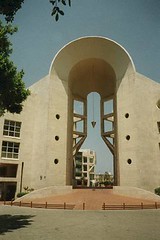
Last night I went to hear/see "Wozzeck" for the first time. I had heard excerpts in my younger days and concluded that it was not for me: no singable tunes, in fact no recognizable melodies at all. Then I heard some parts of "Wozzeck" on the radio last week (local classical music station), and was mesmerized. I jumped at the chance to go with a friend. I even brought along my parents' libretto, which they had bought for $.75 at a New York Metropolitan Opera performance in 1952, although there were super-titles in both Hebrew and English. The opera was composed by Alban Berg in 1922; Berg was a student of Arnold Schoenberg.
The plot is an amalgam of German philosophy and Weimar foreboding: a combination of "Jerry Springer - The Opera" and "Othello." A jealous lover, berated by various upper-class stick-figures for being immoral, is betrayed by his mistress, stabs her and himself, but first they sing about it all for 2 hours, and their illegimate child is just about to find out what happened to his mommy when the curtain falls. The music sounds like Kurt Weill collaborated with Gustave Mahler while they were both very, very stoned. It was the first time I found twelve-tone music not only tolerable, but absolutely RIGHT. And the whole opera was performed without intermission.
"Wozzeck" rules!
Monday, February 21, 2005
Kibbutz Visit
Sunday, February 20, 2005
Free Culture!
Who needs Copyright protection and Fair Use laws when you can have live long-distance entertainment for free?
Saturday, February 19, 2005
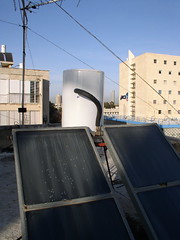
Solar Panels

Thursday, February 17, 2005
Faux Spring in Tel Aviv
Wednesday, February 16, 2005
Savta Dotty's Treasure House (4)
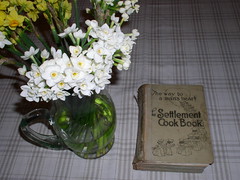
For example, Savta Dotty's own mommy's copy of The Settlement Cookbook, circa 1926.
Long before cookbooks were invented, we used to have relatives. However, when Savta Dotty's own mommy got married to Mr. Dotty, a cookbook was a special, newfangled wedding gift. And the hands-down favorite cookbook in their set was The Settlement Cookbook. The subtitle, "The Way to A Man's Heart," may seem anachronistic, but it's not. The flowers were a gift from a beau of Savta Dotty's who stopped by to sample her apple pie on Valentine's Day.
How many people do you know who still have their own mommy's Settlement Cookbook?
That's why The Settlement Cookbook is one of Savta Dotty's Treasures.
Ya'll come back real soon to see more Treasures!
Tuesday, February 15, 2005
Pie From the Sky, Part Four
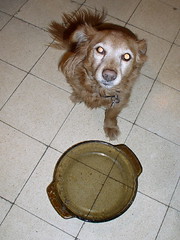
Don't worry about germs. I just got a brand new dood shemesh (that's solar water-heater in English) and the water is now hot hot hot. Besides, they say there are fewer germs in dog saliva than in human.
Monday, February 14, 2005
Pie from the Sky, Part Three
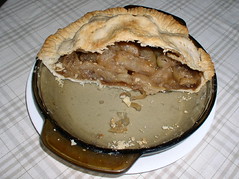
Pie from the Sky, Part Two
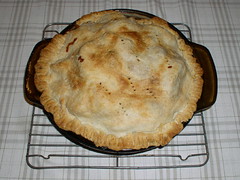
Sunday, February 13, 2005
Savtadotty'sFridge
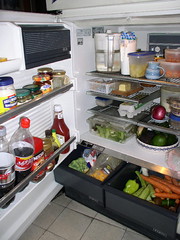
Savtadotty'sFridge
Originally uploaded by savtadotty.
For Udge
I have so many avocados because my friend gave them to me just before she flew off Friday to the USA, to attend her brand-new grandson's Brit.
Thursday, February 10, 2005
Elswhere's Beanstalk
How is writing for beans different from Blogging for Books? or Jumping for Joy? That's it: Blogging for Jumping Beans! I'd better go lie down for a while.
Monday, February 07, 2005
The Stuyvesant Story (6): Ten years later - a surprising vindication
Elswhere has finished grad school, having moved her activism to the Pacific Northwest.
P., graduated from Stuyvesant High School (where he did make new friends) and from college (Math major), is happily married to Pippi Bluestocking in the Pacific Southwest.
I've left the "empty nest" in suburban New Jersey and moved to urban Tel Aviv. I'm sitting in my kitchen one day, reading 'Tis by Frank McCourt. I come upon the chapter about his enrollment at NYU night school, and the wonderful writing teacher he encounters there: Charles Calitri! I count some years on my fingers and decide it has to be the same extraordinary teacher I had for high school English. Ohmygod! Frank McCourt and I had the same writing teacher! I call my high school classmate in New York to share the news!
I resume reading 'Tis and learn that Frank (hiya, Frank!) spent years teaching English in the NYC public school system, first on Staten Island and then at Stuyvesant High School. I count some more years on my fingers (Math major too), and call P.
Me: "Who was your English teacher at Stuyvesant?"
P: "Which one?" [aaargh! toujours precise, this guy]
Me: "Did you have a famous one?"
P:"Oh, yeah. Frank McCourt."
Me: "Was he good?"
P: "He was great. He told great stories. But he was off doing theater stuff with his brother a lot."
Ohmygod again! My faith in the public school system has been vindicated! In a city of millions, my great high school teacher taught my son's great high school teacher! Just like a small town! Engineering works! Will one of Mr. McCourt's students teach one of my grandchildren? Where? Tune in in another 12 years or so. The story is definitely not over! (although I will try to control the exclamation points from now on.)
Update February 2004: Frank McCourt comes to Israel as a U.S.-sponsored "cultural ambassador."
Update January 31, 2005: The following post appears on Smartmom's new blog:
On Wednesday February 9th at 7 p.m., Brooklyn-born author Frank McCourt will be reading at MS 51 on Fifth Avenue between 5th and 6th Streets.
A fund raiser for the talent programs at Park Slope's illustrious Middle School 51, McCourt will be reading excerpts from his new book about teaching English at Stuyvesant High School, "Tis," and "Angela's Ashes."
A reception will follow at the Stone House in the Park at Third Street and Fifth Avenue.
Arise, you Brooklynites! Get yourselves over to Park Slope's MS 51 this Wednesday, February 9, by 7PM, and tell Frank McCourt that Savtadotty and Smartmom sent you.
**********The End**********
This series is dedicated to immigrants who study, and to their teachers.
An Evening Trade Class, Stuyvesant High School, circa 1896
Photo Source: Board of Education. City of New York. The First Fifty Years: A Brief Review of Progress. 1898-1948. Fiftieth Annual Report of the Superintendent of Schools, Board of Education, The City of New York (New York, 1948). NYC Board of Education Archives, Milbank Memorial Library, Teachers College, Columbia University
Sunday, February 06, 2005
The Stuyvesant Story (5): The test and its aftermath
On the test day, we arrive at the old Stuyvesant High School on 15th street.

There are many immigrant multi-generational Asian families with little brothers and sisters accompanying their intensely-serious teenagers. The entrance hall is majestic and crowded.

Families enter the auditorium, where the test will be administered, accompany their teenager to designated seat, give their final blessings, and leave.

The results arrive some days later. P. has passed the test, and is entitled to attend Stuyvesant High School. Uh-oh. Decisions must be made.
The aftermath: First we ascertain that P.'s decision deadline is the first day of school in September. Then he takes tours of the local Alternative and mainstream high schools. Based on her observation of his behavior during the tour of her school (hanging out on the sofa), elswhere advises: the A-school is not for him. He shows too much resemblance to those classmates who descended into a cloud of marijuana smoke and vegetated there. That narrows the field to two.
My thoughts wander: the "today I am a man" message of the Bar Mitzvah, the meaning of puberty for males, and how few life-decisions young suburban teenagers get to make nowadays...Fathers as role models for sons who grow up in single-mom households...Something primal about young men and older men being together...Two parents who live in different homes but both love their kids...The decency of my ex's new wife. Finally, I decide not to decide: P. will have to take new responsibility for his own life and decide this one for himself, using me as sounding-board.
There follows a period of considerable restlessness and indecision for P. I sense a difference in myself: I look at my son as a fledgling grown-up now, no longer a tall little boy. "You're not choosing between your parents: you're choosing your own future." "If it doesn't work out, you can come back." "If you stay at home, I know you'll do well." Helping him think through his decision, I honestly don't have a preferred outcome except for him to decide. Will he choose to stay with his friends? Will he trade the known for the unknown? Dr. Dreikurs, my work is just about done.
I think it was mid-July when he woke up more refreshed than I'd seen him in months and said: "I've decided. I'm going to go to Stuyvesant. But I won't have a Moving Day. Every weekend from now on I'll take some stuff over to Dad's, until most of my stuff is there. I was able to make good friends here, so I should be able to make more good friends there too. And once school starts, I'll come back here on weekends to see my old friends." And that was what happened.
**********End of Part 5**********
One more episode to come...tomorrow...The Finale
6. Ten years later: a surprising vindication
Saturday, February 05, 2005
The Stuyvesant Story (4): The Little Engine That Could Stalled
Prowesslessnesslessness's Jr. High experiences and High School options
My child-rearing bible was Children: the Challenge by Rudolph Dreikurs. I remember one phrase from it: "A broken ego is harder to fix than a broken bone." Dreikurs' advice was to interfere as little as possible with your children's age-appropriate interactions with the outside world ("natural consequences"), but to make maximum efforts to engineer situations to sidestep power struggles. (Child-proofing the house instead of saying "No!" all day long - an example of Dreikurs applied for crawlers and toddlers.)
The suburbs were more "child-proof" than the city, in most ways. But divorce is a family
As long as public school wasn't too boring, they enjoyed reading on their own, and they had nice friends of a heart-warming variety of colors and ethnicities, I was satisfied that we were all doing the best we could. True, there was a certain lack of socio-economic diversity, but we did have the lower-income sections of town feeding into our Junior High School. And acceleration in Junior High (the SP program) had been replaced by an enrichment program for the Gifted and Talented, which kept the regular classes integrated and the spark alive, at least for elswhere.
My son has chosen the alias "Prowesslessnesslessness." He thinks it will discourage spammers. The fact that it discourages everyone and involves endless typing is what he likes about it: he never types it, and the people who matter to him know his name. This may be a clue to his character since birth:
"Unless you are truly qualified to share my music/puzzles/games, leave food on a tray outside the door. I am happily preoccupied here on Planet P."
He really was happily preoccupied. Math was fun for him. He'd been reading forever. He had perfect pitch. He was well-behaved. When he got tired, he went to sleep - no drama. He scored top on tests. I could predict the report cards, year after year: "It is a pleasure to have P. in my class." [Note: elswhere's teachers gave me the same reports, but she was more sociable.] By the time he started Junior High, I was beginning to worry that our public school system would become too boring for P., even with the benefits of the Gifted and Talented program, and boredom meant Trouble.
By the time P. was 14, his interest in school was waning and all he wanted to do was play his drums. P.'s choices for high school in our town were the mainstream or the alternative high school, ("oasis for teenage outcasts, heaven for me", says elswhere). P.'s dad, who had remarried and was living in Queens, proposed a third option for him: Stuyvesant High School in Manhattan. "Just let him take the test," he said. My ex made reference to his fond memories of the Bronx High School of Science, challenge, stimulation, etc. I asked if his wife was ready to have P. live with them, because Stuyvesant was for NYC residents only? Yes, she was. Was our Test Gladiator willing to spend a winter morning in New York filling in boxes with a #2 pencil to please his dad? Yes, he was. I assumed P. would live away from me at college when he reached 18: was I willing to let him live away from me for high school at 15? I decided to wait until the test results arrived to worry about that one.
**********End of Part 4**********
Two more episodes to come...
5. The Stuyvesant test and its aftermath
6. Ten years later: a surprising vindication
Friday, February 04, 2005
The Stuyvesant Story (3): Divorce, and the Jewish education clause
To get a "no-fault" divorce New Jersey, we had to live apart for one year (or eighteen months – I'm not certain…all you New Jersey divorce law historians out there will know). It took us a long time to agree on the terms of separation, and during that period I had to find a part-time job and make child-care arrangements.
Returning to the business world with a resume showing 8 years of programming experience followed by 7 years of "maternity leave" was a rousing challenge. I tapped every contact I ever had, went on a few interviews, and finally was offered what seemed to be the ideal re-entry job: a 15-minute drive from home, 6 hours a day, using a programming language I already knew. Never mind that the salary was on the low side and the work was boring.
There were no after-school programs with affordable transportation; in fact there were hardly any after-school programs at all, other than art, dance, and music lessons, and they required SAHMs-cum-chauffeurs. I found an elderly woman baby-sitter who lived nearby and who agreed to come over to "bridge" the few hours between my son's return from half-day kindergarten and my return from work at 3:15. The arrangement worked until her health failed. By that time it was almost summer and Day Camp. My mother was called in for emergency duty for a few weeks.
The last obstacle to concluding our negotiations involved my husband's late-addition custody clause in the separation agreement. We had already agreed I would get custody, and his visitation rights and arrangements were straightforward. Joint custody would not have been realistic: he had a full-time job and was moving back to a small apartment in NYC. The item he added at the last minute read something like: "the children will be provided with some form of Jewish education until Bar/Bat Mitzvah." I was really surprised.
Jewish education? We were Jewish parents. Wasn't that enough? Our children had only Jewish grandparents, aunts, uncles, and cousins. We had never discussed formal Jewish education for the children. My husband's parents were Yiddish-speaking socialists. Never mind that his mom kept Kosher...it was a cultural thing for her. The only "religious" thing he did was fast on Yom Kippur. I didn't. When we got married, we were going to be a secular Jewish family, just like our friends. True, we served fish at our wedding lunch to accommodate his mom's dietary preferences. True, we joined a local synagogue in our new town, but that was just to be able to enroll our son in their nursery school, and we never went to services after the first sample. I read the clause and thought for a while: he didn't say I had to send them to a Yeshiva, he's willing to pay half the tuition, how much harm can it do, it will end the endless back-and-forth, I'm worn out, let's just get this over with already. I signed.
**********End of Part 3**********
Three more episodes to come...
4. Prowesslessnesslessness's Jr. High experiences and High School options
5. The Stuyvesant test and its aftermath
6. Ten years later: a surprising vindication
Thursday, February 03, 2005
The Stuyvesant Story (2): I Get Up In The Morning and I Put On My Car
Moving from Manhattan to N.J. in the '70s for public schooling (among other things)
As for what happened in the ten years between College and the Sandbox, the abbreviated version is: computer programming (at a time when most people thought it had something to do with television programs); a year's "leave of absence" to
For now, let's resume in the late 1960's. I am married, living with my husband, a toddler, and an infant, in a classic Upper West Side rent-controlled 2-bedroom-plus-maid's-room apartment with real parquet flooring and high ceilings, built in 1928 for occupants who actually had live-in maids. After a brief experiment with part-time contract programming work (on-site...we're talking Main Frame computers here, no PCs) following the arrival of our first child, I decided that juggling home and work demands was too much conflict for me: I became a Stay At Home Mom (SAHM). To the extent that it was preserved at all, my sanity was attributable to choral singing and communing with the other SAHMs in Riverside Park.

We would meet at least once a day at the sandbox, where the topics du jour were much the same as mommy blogs today: Child-rearing Best Practices, local events of interest, gossip, pregnancies, twins, book and movie reviews. We founded a co-operative three-morning-a-week toddler day-care center. We founded a fresh fruit-and-vegetable co-op, supplied by weekly trips to the Bronx Terminal Market in Hunt's Point (in a borrowed station wagon).

We founded a parental baby-sitting exchange. Our community was preoccupied with daily life, plodding dutifully toward the Kindergarten Milestone.
Our options were four: local public school, non-local public school, private school, or move (we never considered home schooling). We rejected the non-local public school option first, because it involved fabricating evidence of residence in the district of the school. Such fabrication would involve our children in deception of the school authorities. This did not model behavior we wanted them to learn from us.
The local public school I rejected outright. It was too scary. During the 1970's the Upper West Side was rife with drug addicts. Muggings and burglaries were part of daily local-event reports at the sandbox. Our neighborhood school was "a rough school," and kids regularly had their lunches stolen by bullies with weapons. It was on the other side of
As for private schools, even then there was competition and screening of parents and kids, not a pleasant ordeal. The variety available was more than
The decision about school turned out to be a decision about values and identity (surprise!) Both my husband and I were products of public schools in predominantly Jewish neighborhoods. Our parents had settled in places surrounding by newcomers like themselves, recovering from fear of pogroms and 20-year army conscription. Paying a large portion of our limited income for private school made both of us uncomfortable: it felt like we were trading in our social consciences and immigrant pride for social elitism. Even so, to avoid moving, we tried it for our older child.
We chose a small, unpretentious school close to home. After the first year, we were not impressed. Our daughter wasn't doing much more than she had done in nursery school, at more than twice the price plus van transportation. It didn't seem like we were getting good "value," and made us feel like either fools or hypocrites or both. Our six rooms were on a low floor, surrounded by other buildings; there was too little light. We could use the price of the double tuition bill to buy more light, trees, and a backyard.
For a brief, insane, period we considered buying a rundown brownstone in "the jungle" to renovate. That would have been a dandy investment, but it would not have solved our school problem, and I was certain our marriage wouldn't bear the stress. To this day I consider families who survived that ordeal true Superheroes. Instead, we decided to look for a house in the suburbs, choosing a location with public schools that matched our priorities: safety, as much racial and economic diversity as possible, and reasonable academic standards. Both my kids were already reading (I had read a book about putting big red signs on everything, and the kids were interested), so I had no doubts about their learning abilities.
I remember two tell-tale "must haves" on our home-buying list: sidewalks and a convenience store within walking distance. We were not ready for a sudden transition to a car-dependent lifestyle. We moved the week after Thanksgiving, and elsewhere took a big yellow school bus to her integrated first-grade. Prowesslessnesslessness celebrated his 3rd birthday in our new home while recovering from Moving Day Bronchitis, and then I joined my first car-pool transport him to nursery school. For most of the next 12 years, I would get up in the morning and put on my car.
**********End of Part 2**********
Four more episodes to come (I consolidated two)...
3. Divorce, and the Jewish education clause
4. Prowesslessnesslessness's Jr. High experiences and High School options
5. The Stuyvesant test and its aftermath
6. Ten years later: a surprising vindication
Tuesday, February 01, 2005
(Updated) The Stuyvesant Story (1): Public School Experience in the '40s and '50s
I am the youngest child of immigrant parents. My mother was about 7 when she arrived to join her widowed mother and 4 older siblings in Manhattan. She had been left in foster care in the port of Antwerp until her mother, teenage sisters and brothers were settled. (If you think you have child care problems, imagine trying to immigrate as a single mother with five children and severely limited assets!) Like a mother cat transporting her kittens, my young grandmother, who worked for a steamship line expressly for this purpose, took her two oldest across the Atlantic to the New World first, leaving the other three in a variety of foster homes, none of which would accept all three together. During her Antwerp months my mother was educated by Catholic nuns, but she requested public school when she arrived in the USA.
The legendary American melting pot was boiling at that time, that is to say about 100 years ago. My mother told me her teachers spent some part of each day teaching "hygiene" to the children, examining their ears and their handkerchiefs to be sure they were clean. Everyone she knew was a renter, and it was not uncommon for some children to drop out of school even before high school, to work to help their families survive. My mother, being the youngest, and mathematically and musically talented, was able to attend high school at the Institute of Musical Arts, founded by Dr. Frank Damrosch, the godson of Franz Liszt and the head of music education for New York City's public schools. It was on Claremont Avenue, and later merged with the Juilliard School of music at the same location.
We now fast-forward from my birth in the Bronx to the school years in a primarily Jewish "striver" neighborhood in Queens. There were a few three-generation families with non-English-speaking or heavily-accented grandparents. A mother who worked outside of home was exceptional. In my growing-up world, all mothers had a calling to be homemakers. From what I could see, they had plenty of "d" power: deciding décor, dress, diet, doctors, and dentists. The fathers were mostly salesmen, small business partners, or skilled craftsmen: they had jobs, not careers.
Public schools were taught by teachers happy to have secure jobs after the Great Depression. In elementary school, most principles were men, all teachers were women. WWII was in progress and no new schools were built; materials were reserved for "the war effort." To maximize use of crowded space, our school was divided into three overlapping sessions, starting at 8AM, 11AM, and 2PM. My first several years of school were in the afternoon sessions. We had air-raid drills and wore ID tags. Some of the teachers lived in our neighborhood, others commuted (by subway - gas was rationed).
My after-school activities were piano lessons (from Mom), dance lessons, street games, roller-skating , bike rides, Girl Scouts, and occasionally ice skating at the rink in the converted NY State building leftover from the 1939 World's Fair, near where Shea Stadium is now located. For three years my oldest brother was represented by a pin on a map on the dining room wall, a pin moving to update the Pacific Ocean location of his U.S. Navy ship according to the v-mail information that had got past the military censors.
In 6th grade we all took a Stanford-Binet Stanford-Binet IQ test to determine who would attend the Special Progress (SP) program the following year. The SP program compressed the 3 years of the Junior High School curriculum into 2 years, allowing gifted students to start the 10th grade at age 13, and finish high school by age 16. The program served the unabashed intensely ambitious goals of its constituents in the NYC public school system.
Sports and entertainment were luxurious pastimes for us high school kids in the '50s. On Saturday afternoons we went to the movies, but otherwise our preoccupation was education, education, and more education. It came as a relief that post-war prosperity funded summers at sleepaway camp.
Our local public high school was the best in Queens and did not require a selective entrance exam, unlike Bronx Science (where my as-yet-unknown future husband was studying), Peter Stuyvesant, and Brooklyn Tech. Also, unlike those high schools, our high school had three tracks: Academic (college-bound), Vocational, and General. On the vocational track, boys learned auto mechanics and carpentry, and girls learned secretarial subjects. I don't know what the General Track was for. As far as I knew from our combined gym classes, there was not one Jewish kid on the Vocational or the General track.
Throughout high school we were subjected to semi-annual standardized tests, to evaluate what we had learned in each academic subject: English, Science, Math, History, Social Studies, and Foreign Languages. I was surprised to discover that these State Regents exams are still given in New York. We were fortunate to have some really fine teachers, some of whom were men, and at least one of whom had a PhD, in biology. The language teachers were often native speakers of the European languages they taught, probably because of that moment in the immigration history of New York. Many English teachers were products of Catholic parochial education.
My favorite and best English teacher, Mr. Calitri, was of Italian-Jewish origin. Mr. Calitri assigned us the New York Times Book Review every Friday. He had us eagerly reading and writing book reports and essays. All the girls had crushes on him, because he was young, sensitive, and secure in his teaching skills. He was the only teacher I ever had who invited a group of us to his home for a evening of readings. We were dismayed to discover that he had a loving wife and a new baby to rival our bids for his attention. During our last high school summer, his first novel, Rickey, was published. The New York Times review was not a rave, but he continued writing. To supplement his modest salary, he moonlighted in the Bloomingdale's liquor store (just over the 59 Street Bridge!) and also taught a college course in creative writing.
Our high school graduating classes did well in state competitions for Regents scholarships to college, and usually produced finalists in the Westinghouse Science Competition, which is now known as the Siemens Westinghouse Competition in Math, Science & Technology .
I attended an Ivy League college, too young and socially immature, but well-prepared academically.
**********End of Part 1**********
Six more episodes to come...
2. Moving from Manhattan to N.J. in the '70s for public schooling (among other things)
3. Divorce, and the Jewish education clause
4. Prowesslessnesslessness's Jr. High experiences [SD: Combined with 5.]
5. Prowesslessnesslessness's High School options
6. The Stuyvesant test and its aftermath
7. Ten years later: a surprising vindication
UPDATE STARTS HERE
My father immigrated twice: first from Eastern Europe to London's East End, as an infant together with his mother and stepfather, and second from London to New York, having deserted the British army, single, in his early 20's. He had barely arrived when the U.S. entered WWI, and he was immediately drafted into the U.S. Army, where he served in the Ordinance Corps at the Watervliet Arsenal. When WWI ended, he found work as a technician, and continued his education at night in the Engineering School of Cooper Union College.
Planning the Stuyvesant Story
1. Background: public school experiences in the '40s and '50s
2. Moving from Manhattan to N.J. in the '70s for public schooling (among other things)
3. Divorce, and the Jewish education clause
4. Prowesslessnesslessness's Jr. High experiences
5. Prowesslessnesslessness's High School options
6. The Stuyvesant test and its aftermath
7. Ten years later: a surprising vindication
Tune in tomorrow for Section 1.