If you have not done so already, please go immediately to Sara Crewe on Flight 105
Elswhere (my daughter!) keeps outdoing herself.

Saturday, April 30, 2005


Friday, April 29, 2005
Quirky Minds
The other day, for many good reasons, I was thinking, "The world is going to Hell in a handbasket." Nothing unusual about that thought. But then I started wondering what the handbasket looked like. And now I'm obsessed with visions of handbaskets.
Am I the only one with a quirky mind like that? Surely not.
Am I the only one with a quirky mind like that? Surely not.
Wednesday, April 27, 2005
Harbinger of a Good Day
I took the butter out of the fridge to soften early enough: my matzoh didn't shatter when I buttered it.
Monday, April 25, 2005
Ayzeh Mehdeenah (7) - The Holiday Train
I can't stop smiling when I think about the train ride home from Zichron Yaakov last night. It was the first train after the two-day Shabbat+Passover stoppage, and fairly crowded.
1. When Miriam, "Shuki" and I boarded, we entered the bottom of a double-decker car, and a smiley murmur went up from the passengers. It turned out we were bringing the seventh dog on board in that car! (Muzzles and 1/2-price tickets are required for dogs.) Non-dog owners asked: is there a dog show in Tel Aviv tonight? They were all very well-behaved, and only the littlest one barked.
2. The train tracks run parallel to the highway from Haifa, and we could see the traffic backed up as we glided smoothly along (shadenfreude).
3. The young man seated next to me had a cellphone that played "Avadim Hiyenu" (one of the classic Seder songs) as his ringtone.
1. When Miriam, "Shuki" and I boarded, we entered the bottom of a double-decker car, and a smiley murmur went up from the passengers. It turned out we were bringing the seventh dog on board in that car! (Muzzles and 1/2-price tickets are required for dogs.) Non-dog owners asked: is there a dog show in Tel Aviv tonight? They were all very well-behaved, and only the littlest one barked.
2. The train tracks run parallel to the highway from Haifa, and we could see the traffic backed up as we glided smoothly along (shadenfreude).
3. The young man seated next to me had a cellphone that played "Avadim Hiyenu" (one of the classic Seder songs) as his ringtone.
Thursday, April 21, 2005
Dreams and Reality
The dream
In my dream seder, both my children, their life-partners and their children, arrive at my home, which has magically enlarged itself to accommodate them all, and my dog has magically transformed herself into a guaranteed-non-allergenic, looks-like-a-cat, housepet the size of a small turtle, two or three days ahead of Seder night. We have a family powwow regarding the construction of the seder menu, given the various persuasians of vegetarianism and traditionalism that prevail among us. The result is a shopping-and-cooking battle plan that goes into effect the next day, following instant absence of jet lag. My function in this assembly is purely matriarchal: baby-minding The Little Bear with the aid of my older granddaughter, Mermaid Girl, assisting in tour-guiding through the labyrinthine grocery store, coordinating various snacks and pre-Meal meals, and answering ponderous questions such as "where is the spatula?" and "do we have enough Haggadot?"
The Seder itself is a combination of Israeli and modern emancipated American rituals, enlivened by guest children slightly older than MG, so that she is the youngest and therefore entitled to the honor of asking the Four Questions, which she does with great charm and self-possession, but also modesty. Discussions of the meanings of the story are stimulating and many new insights are offered by various participants. The singing of songs is enthusiastic, and everyone, including me, knows all the words in Hebrew, and all the melodies. (This is my dream, don't forget.)
The food is plentiful and delicious, of course, and the many cups of wine, including additional ones for the many new Politically Correct Causes that have arisen over time, increase the sound level and the general jollity. By the end of the evening, a magical joy has enveloped the party, guests leave reluctantly, and everyone remaining wants to put the children, who have fallen asleep quietly wherever they were, properly to bed and clean up the kitchen together.
The reality
My friend Miriam and I and my dog take the train to Zichron Yakov, where the newly-divorced brother of Pippy Bluestocking awaits us, with custody of his two daughters and a vast shopping list. We proceed to shop, clean and cook for two days, allowing occasional interruptions for sleep, until the Seder, while Miriam's and my children and grandchildren, all in the USA, attend seder meals at their respective homes or at the homes of other relatives. If we're lucky, the Zichron sisters won't fight too much.
In my dream seder, both my children, their life-partners and their children, arrive at my home, which has magically enlarged itself to accommodate them all, and my dog has magically transformed herself into a guaranteed-non-allergenic, looks-like-a-cat, housepet the size of a small turtle, two or three days ahead of Seder night. We have a family powwow regarding the construction of the seder menu, given the various persuasians of vegetarianism and traditionalism that prevail among us. The result is a shopping-and-cooking battle plan that goes into effect the next day, following instant absence of jet lag. My function in this assembly is purely matriarchal: baby-minding The Little Bear with the aid of my older granddaughter, Mermaid Girl, assisting in tour-guiding through the labyrinthine grocery store, coordinating various snacks and pre-Meal meals, and answering ponderous questions such as "where is the spatula?" and "do we have enough Haggadot?"
The Seder itself is a combination of Israeli and modern emancipated American rituals, enlivened by guest children slightly older than MG, so that she is the youngest and therefore entitled to the honor of asking the Four Questions, which she does with great charm and self-possession, but also modesty. Discussions of the meanings of the story are stimulating and many new insights are offered by various participants. The singing of songs is enthusiastic, and everyone, including me, knows all the words in Hebrew, and all the melodies. (This is my dream, don't forget.)
The food is plentiful and delicious, of course, and the many cups of wine, including additional ones for the many new Politically Correct Causes that have arisen over time, increase the sound level and the general jollity. By the end of the evening, a magical joy has enveloped the party, guests leave reluctantly, and everyone remaining wants to put the children, who have fallen asleep quietly wherever they were, properly to bed and clean up the kitchen together.
The reality
My friend Miriam and I and my dog take the train to Zichron Yakov, where the newly-divorced brother of Pippy Bluestocking awaits us, with custody of his two daughters and a vast shopping list. We proceed to shop, clean and cook for two days, allowing occasional interruptions for sleep, until the Seder, while Miriam's and my children and grandchildren, all in the USA, attend seder meals at their respective homes or at the homes of other relatives. If we're lucky, the Zichron sisters won't fight too much.
Tuesday, April 19, 2005
Happy Passover!
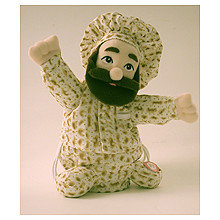
How lucky that Passover lasts a week - that means there's still time for you to get your very own Dancing Matzah Man, US$18. including batteries (plus shipping)!
Sunday, April 17, 2005
Miriam's Garden Party
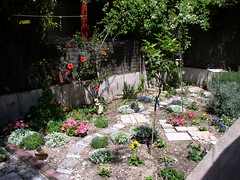
Yesterday afternoon we were all eating cheese, drinking wine, and congratulating Miriam and her garden designer for their lovely results. This little oasis is in the middle of Tel Aviv, very near the shuk!
Saturday, April 16, 2005
Ayzeh Mehdeenah (6) - Manners
Years ago I read this anecdote in an AACI newletter, and it stayed with me.
After a few years' patronizing the same bank, I became friendly enough with the bank teller for her to ask me:
Bank Teller: "Why do you Americans think we're rude? What do we do that makes you think that?"
I paused, knowing she was sincere, and I didn't want to insult her or hurt her feelings.
Me: "Well, for example, here you are, working directly with the public, while drinking tea and eating a cucumber at the same time."
The teller looked mystified, then she looked at me quizzically, and asked, "Well what should I be eating?"
After a few years' patronizing the same bank, I became friendly enough with the bank teller for her to ask me:
Bank Teller: "Why do you Americans think we're rude? What do we do that makes you think that?"
I paused, knowing she was sincere, and I didn't want to insult her or hurt her feelings.
Me: "Well, for example, here you are, working directly with the public, while drinking tea and eating a cucumber at the same time."
The teller looked mystified, then she looked at me quizzically, and asked, "Well what should I be eating?"
Wednesday, April 13, 2005
Savta Dotty's Treasure House (6)
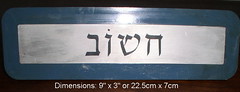
I worked for IBM a long long time ago, (even before elswhere was born), and I was thrilled to get a "Think" sign in Hebrew. OK, you Hebrew-speakers, what does it really say?
Tuesday, April 12, 2005
Aristedes de Sousa Mendes
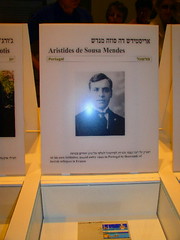
Yesterday I took the train to Jerusalem and visited the new Yad VaShem museum. There, among the Righteous Gentiles exhibit, together with Oskar Schindler and his original list, was Aristedes de Sousa Mendes, as noted by The Lioness back in October.
More photos from my excursion can be seen at Flickr, tagged "yadvashem" and "train".
More photos from my excursion can be seen at Flickr, tagged "yadvashem" and "train".
Monday, April 11, 2005
Ayzeh Mehdeenah* (5) - Security
(4) Davka
(3) Hebrew School
(2) August 29-30, 1988
*(1) Definitions and Intro
Nothing put me to sleep faster than doing Hebrew homework. In fact, I had no trouble sleeping from the day I landed in Israel, even before I started Ulpan. This in happy contrast to my growing insomnia the preceding few years. In Israel I could fall asleep anywhere, not just my room or on a bed. On buses, on sofas in other people's homes, on the beach, and even, one time, on the outdoor patio of a community center where a sculptor friend of mine was installing an exhibition. I felt as safe as a baby. We assume a person who sleeps on the street is "homeless," but I really feel that anywhere in Israel is my home. Am I deluded? If I am, at least I'm not alone. And I do have a street address and phone number, for backup. Pehaps adjusting to life in Israel was so exhausting that I was sleepy all the time, but being sleepy and falling asleep are two different things, as any insomniac can tell you.
Another indicator of my newly-acquired feelings of safety came to me as I walked around Tel Aviv after class at Ulpan Meir. I felt no need to use my "Manhattan walk:" my late-for-an-important-meeting walk, purposeful, avoiding eye contact. I could safely meander down Rothschild Boulevard, study the architecture of both new and decrepit buildings. Once on King George Street I was doing this so intently that I collided with a lamppost. To my great relief, no one laughed at my goof, making me wonder whether people-walking-into-lampposts was a common occurance in Tel Aviv. I felt just as safe strolling about Tel Aviv at night, even alone. I still do, although the second intifada has made me little more aware of who's around me.
Once I left a folder of documents on a café chair and went off to a job interview. After the interview, I returned to the café, hoping to find my documents, and there they were! Since then, whenever I've left a jacket, an umbrella, a book, even a credit card (!), at an Israeli business establishment, it's always been saved for me. Always (tfu tfu tfu). I like to think the Talmudic law about returning lost possessions persists even in modern secular Israel. After all, it's part of "what we do," even when we don't know why. Maybe I've just been lucky.
Another nice, related, convention here is when something, like a glove or a baby's pacifier, is dropped on the street and you find it, you're supposed to pick it up and leave it at eye level, to make it easier for the person who lost it to find it. This happened once when my cellphone dropped one Friday morning as I was walking Shuki and reading the Jerusalem Post, and resulted in a Big Incident. It was right after the start of the second intifada, and unattended cellphones were suspected of being bomb detonators. Ten minutes into my walk, I realized I had lost the phone, so I retraced my steps and asked everyone I saw whether they had seen it, including the vendors at the kiosk. No luck. I got home and called my cellphone number and a policeman answered. After he asked me some questions to evaluate whether I sounded like a suicide bomber, he must have concluded that I didn't, because he told me to run right over to where he was, or they would call the sappers in three minutes. When I got there, a few buildings away from the kiosk, a small crowd had already gathered to witness my "crime." Some well-bred Tel Avivian had picked up the fallen cellphone and placed in on the trunk of a parked car, where it could be seen more easily but my eyes had been seeking it on the ground. And, even more suspiciously, the car was legitimately parked in a space reserved for the vehicle of a disabled person.
This doesn't mean there is no street crime: cars and wallets are stolen quite often. One Thursday evening my wallet was picked out of my pocket at the Mahane Yehuda market in Jerusalem. I reported it to the police, but it wasn't found. I was sadder about the lost photos than the money. And about two months ago, on a bus, I observed a guy stick his hand into the small pocket of a backpack as we were getting off the bus. I thought he was the boyfriend of the backpack-wearer (amazing how we construct scenarios about human interactions), and it wasn't until they got off the bus and went off in separate directions without any goodbye or eye contact that I realized he had probably stolen her wallet.
(3) Hebrew School
(2) August 29-30, 1988
*(1) Definitions and Intro
Nothing put me to sleep faster than doing Hebrew homework. In fact, I had no trouble sleeping from the day I landed in Israel, even before I started Ulpan. This in happy contrast to my growing insomnia the preceding few years. In Israel I could fall asleep anywhere, not just my room or on a bed. On buses, on sofas in other people's homes, on the beach, and even, one time, on the outdoor patio of a community center where a sculptor friend of mine was installing an exhibition. I felt as safe as a baby. We assume a person who sleeps on the street is "homeless," but I really feel that anywhere in Israel is my home. Am I deluded? If I am, at least I'm not alone. And I do have a street address and phone number, for backup. Pehaps adjusting to life in Israel was so exhausting that I was sleepy all the time, but being sleepy and falling asleep are two different things, as any insomniac can tell you.
Another indicator of my newly-acquired feelings of safety came to me as I walked around Tel Aviv after class at Ulpan Meir. I felt no need to use my "Manhattan walk:" my late-for-an-important-meeting walk, purposeful, avoiding eye contact. I could safely meander down Rothschild Boulevard, study the architecture of both new and decrepit buildings. Once on King George Street I was doing this so intently that I collided with a lamppost. To my great relief, no one laughed at my goof, making me wonder whether people-walking-into-lampposts was a common occurance in Tel Aviv. I felt just as safe strolling about Tel Aviv at night, even alone. I still do, although the second intifada has made me little more aware of who's around me.
Once I left a folder of documents on a café chair and went off to a job interview. After the interview, I returned to the café, hoping to find my documents, and there they were! Since then, whenever I've left a jacket, an umbrella, a book, even a credit card (!), at an Israeli business establishment, it's always been saved for me. Always (tfu tfu tfu). I like to think the Talmudic law about returning lost possessions persists even in modern secular Israel. After all, it's part of "what we do," even when we don't know why. Maybe I've just been lucky.
Another nice, related, convention here is when something, like a glove or a baby's pacifier, is dropped on the street and you find it, you're supposed to pick it up and leave it at eye level, to make it easier for the person who lost it to find it. This happened once when my cellphone dropped one Friday morning as I was walking Shuki and reading the Jerusalem Post, and resulted in a Big Incident. It was right after the start of the second intifada, and unattended cellphones were suspected of being bomb detonators. Ten minutes into my walk, I realized I had lost the phone, so I retraced my steps and asked everyone I saw whether they had seen it, including the vendors at the kiosk. No luck. I got home and called my cellphone number and a policeman answered. After he asked me some questions to evaluate whether I sounded like a suicide bomber, he must have concluded that I didn't, because he told me to run right over to where he was, or they would call the sappers in three minutes. When I got there, a few buildings away from the kiosk, a small crowd had already gathered to witness my "crime." Some well-bred Tel Avivian had picked up the fallen cellphone and placed in on the trunk of a parked car, where it could be seen more easily but my eyes had been seeking it on the ground. And, even more suspiciously, the car was legitimately parked in a space reserved for the vehicle of a disabled person.
This doesn't mean there is no street crime: cars and wallets are stolen quite often. One Thursday evening my wallet was picked out of my pocket at the Mahane Yehuda market in Jerusalem. I reported it to the police, but it wasn't found. I was sadder about the lost photos than the money. And about two months ago, on a bus, I observed a guy stick his hand into the small pocket of a backpack as we were getting off the bus. I thought he was the boyfriend of the backpack-wearer (amazing how we construct scenarios about human interactions), and it wasn't until they got off the bus and went off in separate directions without any goodbye or eye contact that I realized he had probably stolen her wallet.
Friday, April 08, 2005
Ayzeh Mehdeenah* (4) - Davka
*definitions
[Note to Hebrew-speaking readers (as if you needed encouragement): please add examples, send corrections, emendations, elucidations, opinions, to my risk-loving attempt at explaining this unexplainably wonderful term. ]
The Hebrew term davka (דווקא) is usually an interjection, sometimes an expletive, that implies some kind of contrariness in action, either personal or impersonal:
1. personal - a display of personal power, usually indirect (passive-aggressive). For example:
My guess is there may be a positive feedback loop involved, so that the word and the behavior encourage each other – a chicken-and-egg situation. The term wouldn't have come into common usage without the behavior it describes, and without said behavior being encouraged/needed/observed by the culture. And once they know such a pithy term, people somehow like to use it. But the term also applies to circumstances outside any individual's control, so it could be applied to other languages/cultures.
For a more thorough treatment of cultural differences between Americans and Israelis, read Border Crossings: American Interactions with Israelis by Lucy Shahar and David Kurz.
[Note to Hebrew-speaking readers (as if you needed encouragement): please add examples, send corrections, emendations, elucidations, opinions, to my risk-loving attempt at explaining this unexplainably wonderful term. ]
The Hebrew term davka (דווקא) is usually an interjection, sometimes an expletive, that implies some kind of contrariness in action, either personal or impersonal:
1. personal - a display of personal power, usually indirect (passive-aggressive). For example:
· if you say tomato, I could דווקא say tomahto, just to be different, to be original, to annoy you, to see whether you're paying attention, to keep you on your toes, to get even for your previous annoying behavior towards me2. impersonal: events that occur contrary to what was expected. For example:
· A two-year-old is famous for her דווקא behavior
· I took an umbrella, so of course it דווקא didn't rainJoel Spolsky wrote in his blog, "No matter how debunked the Whorf theory [of linguistic determinism] is, I'm still convinced that Israelis are more likely to do things דווקא, simply because they have a word for it."
· Whenever I leave home early enough to be somewhere on time, there's דווקא a horrendous traffic jam, making me late
My guess is there may be a positive feedback loop involved, so that the word and the behavior encourage each other – a chicken-and-egg situation. The term wouldn't have come into common usage without the behavior it describes, and without said behavior being encouraged/needed/observed by the culture. And once they know such a pithy term, people somehow like to use it. But the term also applies to circumstances outside any individual's control, so it could be applied to other languages/cultures.
For a more thorough treatment of cultural differences between Americans and Israelis, read Border Crossings: American Interactions with Israelis by Lucy Shahar and David Kurz.
Thursday, April 07, 2005
It's My Birthday!
In honor of my birthday today, I'm going to get my annual mammogram. But in the evening there will be a party. My devoted niece sent me a wonderful greeting in which she quotes Helen Hayes: "Age is not important unless you're a cheese."
Is it a coincidence that Oma's first grandchild should be quoting Helen Hayes? Oma's favorite Hayes-ism was, "Old age is not for sissies," although perhaps that one did not originate with Helen.
Is it a coincidence that Oma's first grandchild should be quoting Helen Hayes? Oma's favorite Hayes-ism was, "Old age is not for sissies," although perhaps that one did not originate with Helen.
Tuesday, April 05, 2005
Ayzeh Mehdeenah* (3) - Hebrew School
*definitions
Making Friends
Somehow during those first days I got word that the Americans and Canadians in Israel (AACI) organization was having a party on the Tel Aviv beach my first Thursday night in Israel (equivalent to a TGIF gathering). Looking forward to an evening with English-speakers, I ended up meeting an English-speaking woman from Mexico, who invited me to join her at local Conservative services on Shabbat, after which she was driving down to visit American friends in Ashdod. And so the social networking began.
After my first week of Hebrew class in Beit Millman, I was one miserable student. The teacher seemed to violate all the norms of good teaching I had learned: she played favorites in the class, practiced public humiliation of students, didn't check homework, expressed her political opinions as if she herself were running for office, and generally struck me as very small-minded. And worst of all, none of my classmates seemed to mind.
Being somewhat scientific, I decided to experiment with a different Ulpan, to find out whether the problem was with me or the teacher. If there had been another beginner's class section at the Beit Millman Ulpan I would have tried that first, but there wasn't. Osnat (the wonderful shlicha in Philadelphia) had told me about the Tel Aviv Ulpan system, so I knew I wasn't obligated to stay at the one in Beit Millman. Ulpan Meir in central Tel Aviv had the best reputation at that time, so I decided to transfer.
The administrators at Beit Millman didn't hesitate to express the opinion that I was foolish for wanting to commute for ½ hour by bus to a downtown Ulpan every day instead of simply walking for 2 minutes down two flights of stairs, but they didn't try to stop me. After commuting to work every day for the previous 15 years, I was pretty certain the get-up, get-dressed, and get-out routine would actually be beneficial in my case. Besides, I would have a chance to explore Tel Aviv and observe and meet a wider variety of people: Ulpan Meir was not attached to an immigrant dormitory, so it was patronized by a mix of immigrants living on their own, temporary residents, tourists, and Christian volunteers.
Ulpan Meir
The teacher of the older beginner's class at Ulpan Meir was no better than the one at Beit Millman, although I was much amused by my classmates: a middle-aged Tennessee Southern Baptist couple's struggle with Hebrew was charming. Nevertheless I transferred myself to the younger beginners' class because they were rumored to have a really good teacher, Ruti (gossip sessions during simultaneous class breaks elicited this information). By this time I had concluded that the immersion system was overwhelming me and that, all my former learning strategies would fail, so I might as well just experience the course in as pleasant an atmosphere as possible and hope for a miracle. It was either that or drop out, which I wasn't ready to do. At least in Ruti's class I made friends with diplomats' wives from the USA and France, I remained for the full term (five months, with interruptions for numerous holidays), and even later continued with some private tutoring at Ruti's house in North Tel Aviv. I'm still in contact with the Frenchwoman I first met in Ruti's class, even though she returned to Versailles many years ago.
My two most vivid memories of Ulpan Meir were:
1) the day we listened to a sample news broadcast and studied the sentence "Two soldiers were lightly wounded" (Shnei chayalim niftzau kal…). This introduced an entire lesson on the vocabulary of a besieged country: terrorist, bomb explosion, weapons, win, defeat, retreat, reserve duty, general, captain, lieutenant. I thought: I bet immigrants to the USA at the beginning of the 20th century never learned this vocabulary in their Settlement House night schools. [How 9/11 has since changed all that…crackdown on immigrants…no Settlement Houses…]
2) Ruti's 3-hour lesson on davka, probably the only one I really grokked instantly and can't live without to this day (this word will get a post of its very own; Hebrew-speakers are invited to contribute examples).
After several years of fruitless, frustrating evening classes, one very enjoyable three week session at Ulpan Akiva, – the Five-Star Ulpan, in Netanya – and private lessons, I studied art instead.
Facts vs. truth
It used to be that I would try to speak Hebrew and some Israeli would ask me how long I've been here and as soon as I answered, would proceed to lecture me on how my Hebrew should be better by now. I haven't learned Hebrew yet, but I have learned the art of answering Israeli questions properly: now when I speak Hebrew (I still keep trying) and an Israeli asks me how long I've been here I answer, "Too long."
Making Friends
Somehow during those first days I got word that the Americans and Canadians in Israel (AACI) organization was having a party on the Tel Aviv beach my first Thursday night in Israel (equivalent to a TGIF gathering). Looking forward to an evening with English-speakers, I ended up meeting an English-speaking woman from Mexico, who invited me to join her at local Conservative services on Shabbat, after which she was driving down to visit American friends in Ashdod. And so the social networking began.
After my first week of Hebrew class in Beit Millman, I was one miserable student. The teacher seemed to violate all the norms of good teaching I had learned: she played favorites in the class, practiced public humiliation of students, didn't check homework, expressed her political opinions as if she herself were running for office, and generally struck me as very small-minded. And worst of all, none of my classmates seemed to mind.
Being somewhat scientific, I decided to experiment with a different Ulpan, to find out whether the problem was with me or the teacher. If there had been another beginner's class section at the Beit Millman Ulpan I would have tried that first, but there wasn't. Osnat (the wonderful shlicha in Philadelphia) had told me about the Tel Aviv Ulpan system, so I knew I wasn't obligated to stay at the one in Beit Millman. Ulpan Meir in central Tel Aviv had the best reputation at that time, so I decided to transfer.
The administrators at Beit Millman didn't hesitate to express the opinion that I was foolish for wanting to commute for ½ hour by bus to a downtown Ulpan every day instead of simply walking for 2 minutes down two flights of stairs, but they didn't try to stop me. After commuting to work every day for the previous 15 years, I was pretty certain the get-up, get-dressed, and get-out routine would actually be beneficial in my case. Besides, I would have a chance to explore Tel Aviv and observe and meet a wider variety of people: Ulpan Meir was not attached to an immigrant dormitory, so it was patronized by a mix of immigrants living on their own, temporary residents, tourists, and Christian volunteers.
Ulpan Meir
The teacher of the older beginner's class at Ulpan Meir was no better than the one at Beit Millman, although I was much amused by my classmates: a middle-aged Tennessee Southern Baptist couple's struggle with Hebrew was charming. Nevertheless I transferred myself to the younger beginners' class because they were rumored to have a really good teacher, Ruti (gossip sessions during simultaneous class breaks elicited this information). By this time I had concluded that the immersion system was overwhelming me and that, all my former learning strategies would fail, so I might as well just experience the course in as pleasant an atmosphere as possible and hope for a miracle. It was either that or drop out, which I wasn't ready to do. At least in Ruti's class I made friends with diplomats' wives from the USA and France, I remained for the full term (five months, with interruptions for numerous holidays), and even later continued with some private tutoring at Ruti's house in North Tel Aviv. I'm still in contact with the Frenchwoman I first met in Ruti's class, even though she returned to Versailles many years ago.
My two most vivid memories of Ulpan Meir were:
1) the day we listened to a sample news broadcast and studied the sentence "Two soldiers were lightly wounded" (Shnei chayalim niftzau kal…). This introduced an entire lesson on the vocabulary of a besieged country: terrorist, bomb explosion, weapons, win, defeat, retreat, reserve duty, general, captain, lieutenant. I thought: I bet immigrants to the USA at the beginning of the 20th century never learned this vocabulary in their Settlement House night schools. [How 9/11 has since changed all that…crackdown on immigrants…no Settlement Houses…]
2) Ruti's 3-hour lesson on davka, probably the only one I really grokked instantly and can't live without to this day (this word will get a post of its very own; Hebrew-speakers are invited to contribute examples).
After several years of fruitless, frustrating evening classes, one very enjoyable three week session at Ulpan Akiva, – the Five-Star Ulpan, in Netanya – and private lessons, I studied art instead.
Facts vs. truth
It used to be that I would try to speak Hebrew and some Israeli would ask me how long I've been here and as soon as I answered, would proceed to lecture me on how my Hebrew should be better by now. I haven't learned Hebrew yet, but I have learned the art of answering Israeli questions properly: now when I speak Hebrew (I still keep trying) and an Israeli asks me how long I've been here I answer, "Too long."
Sunday, April 03, 2005
It's Raining, It's Pouring
It's raining, it's pouring,
The old man is snoring,
He went to bed
With a brick on his head
And couldn't get up in the morning.
Why on earth have I carried this bit of doggerel around in my head for over 60 years without knowing what it means? Talk about clutter! Can't wait for the BBC to start a Brain Makeover series.
The old man is snoring,
He went to bed
With a brick on his head
And couldn't get up in the morning.
Why on earth have I carried this bit of doggerel around in my head for over 60 years without knowing what it means? Talk about clutter! Can't wait for the BBC to start a Brain Makeover series.
Saturday, April 02, 2005
Ayzeh Mehdeenah* (2)
*definitions
The taxi from the airport deposited me and my luggage at the entrance to Beit Millman in Ramat Aviv. The wordless greeting on the doorway made me burst into tears of relief.
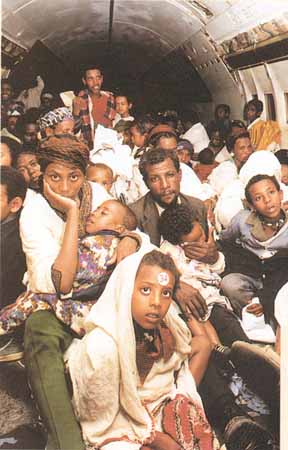
I wiped my eyes to see a receptionist sitting behind a counter, with an array of pigeonholes behind him. The pigeonholes were mailboxes. The guy was taking notes from a book…obviously studying. His skin was black. I was surprised. I later learned all about the several rescues of the Ethiopian Jews, black-skinned people who had been living a pre-rabbinic version of Judaism in Africa for a very long time, and most of them had been living a pre-modern agrarian life until the day they left Gondor. The airplane that brought them to Israel was the first one most of them had ever seen, and the children thought they were inside a giant bird or on a magic carpet.
The receptionist at Beit Millman told me (in English) that he couldn't leave his post because he had to answer the phone whenever it rang. He didn't have a switchboard; just two phone lines. He gave me my key, pointed me to the elevator, and there I was. In the lobby, next to elevator, there were two phone booths, with clunky-looking old dial phones the size of small microwave ovens. The elevator cabin had no door, and the floor buttons on the elevator wall had letters, not numbers. I have a mild fear of heights, and riding in a rickety doorless elevator to mystery floor in my dazed, exhausted, keyed-up state nearly did me in.
My room was at the end of the hall, next to the exit stairs. After that first ride with the luggage, I seldom used the elevator again, not only because of agoraphobia, but because I had decided to adopt a personal survival strategy: minimum contact with the other residents. Walking up and down the back stairs would minimize my encounters with neighbors. I wanted to do this because I had read a book, Lies My Shaliach Told Me, in which the author describes how most new immigrants spend a lot of time complaining to each other. I felt strongly that I would need all my energy to deal with my own problems, and wouldn't be able to process anyone else's, at least not until I knew who was who; my strategy did turn out to serve me well.
My minimally-furnished studio room was intended to be shared, but I was blessed to have no roommate. I lived in fear of having a roommate assigned, but magically one never was. I attribute this to three things: my age, although I was not the only older woman to arrive on her own, my extremely respectful and cooperative attitude toward Frieda, the House Mother (She Who Assigned Roommates), and psoriasis. Frieda may have assumed that roommates would object to my perpetually flaking skin, or they would think it was contagious, or perhaps she herself was repelled. I'll never know for sure, but it was the first time psoriasis may have been an advantage!
The studio had two single beds, two chairs, a small table, one window, a built-in wardrobe, a kitchenette containing a two-burner cooktop and mini-fridge, and a bathroom: toilet, sink, and a combination half-tub/shower. No telephone. Cellphones didn't exist. I would have to learn to use those clunky phones in the lobby booths to make calls.
The first floor above the lobby, called "The First Floor" in that quaint European way, was where the administrative offices and classrooms were. There were offices for representatives of various government Ministries: Absorption, Labor, Education, and The Jewish Agency (Sochnut).
Next morning, Day Two, I showed up for Hebrew School. I didn't need a placement test to be assigned to the beginner's class. The teacher was pregnant. A few of my classmates were in their pajamas. Most of them were Russian or Argentineans. The few other American immigrants had been assigned to advanced classes, or one or two arrived later in the "term." The term had actually begun a week before I arrived, so even my beginner's class was ahead of me: they'd already done the alphabet, a problem that plagues me until today.
The Russians were all refuseniks, some of them (Masha Slepak) were famous heroes of the refusenik movement. Many of the Russians brought their dogs to Israel, not to class, even though house rules did not allow pets. The Argentineans were young, indicators of a failing economy in Argentina rather than any notable Zionism. The teacher made an effort to speak in Hebrew only, which was aided by her ignorance of Russian. From time to time she would toss out a few English words, tidbits for me, but mostly she translated with diagrams and body language only. She was teaching the names of family roles: father, mother, daughter, son, etc. We got a workbook that looked like it had been used for first-graders for generations. I felt totally, but not properly, infantilized: how can it be that there is no Hebrew alphabet song? In 16 years' on-and-off searching, I've not found one. A plea: if anyone of you knows [of] a Hebrew alphabet song, please e-mail me.
Ulpan classes went from 8AM until 1PM, with two intermissions. By the end of class I was too tired to eat lunch and fell asleep for three hours.
The taxi from the airport deposited me and my luggage at the entrance to Beit Millman in Ramat Aviv. The wordless greeting on the doorway made me burst into tears of relief.

I wiped my eyes to see a receptionist sitting behind a counter, with an array of pigeonholes behind him. The pigeonholes were mailboxes. The guy was taking notes from a book…obviously studying. His skin was black. I was surprised. I later learned all about the several rescues of the Ethiopian Jews, black-skinned people who had been living a pre-rabbinic version of Judaism in Africa for a very long time, and most of them had been living a pre-modern agrarian life until the day they left Gondor. The airplane that brought them to Israel was the first one most of them had ever seen, and the children thought they were inside a giant bird or on a magic carpet.
The receptionist at Beit Millman told me (in English) that he couldn't leave his post because he had to answer the phone whenever it rang. He didn't have a switchboard; just two phone lines. He gave me my key, pointed me to the elevator, and there I was. In the lobby, next to elevator, there were two phone booths, with clunky-looking old dial phones the size of small microwave ovens. The elevator cabin had no door, and the floor buttons on the elevator wall had letters, not numbers. I have a mild fear of heights, and riding in a rickety doorless elevator to mystery floor in my dazed, exhausted, keyed-up state nearly did me in.
My room was at the end of the hall, next to the exit stairs. After that first ride with the luggage, I seldom used the elevator again, not only because of agoraphobia, but because I had decided to adopt a personal survival strategy: minimum contact with the other residents. Walking up and down the back stairs would minimize my encounters with neighbors. I wanted to do this because I had read a book, Lies My Shaliach Told Me, in which the author describes how most new immigrants spend a lot of time complaining to each other. I felt strongly that I would need all my energy to deal with my own problems, and wouldn't be able to process anyone else's, at least not until I knew who was who; my strategy did turn out to serve me well.
My minimally-furnished studio room was intended to be shared, but I was blessed to have no roommate. I lived in fear of having a roommate assigned, but magically one never was. I attribute this to three things: my age, although I was not the only older woman to arrive on her own, my extremely respectful and cooperative attitude toward Frieda, the House Mother (She Who Assigned Roommates), and psoriasis. Frieda may have assumed that roommates would object to my perpetually flaking skin, or they would think it was contagious, or perhaps she herself was repelled. I'll never know for sure, but it was the first time psoriasis may have been an advantage!
The studio had two single beds, two chairs, a small table, one window, a built-in wardrobe, a kitchenette containing a two-burner cooktop and mini-fridge, and a bathroom: toilet, sink, and a combination half-tub/shower. No telephone. Cellphones didn't exist. I would have to learn to use those clunky phones in the lobby booths to make calls.
The first floor above the lobby, called "The First Floor" in that quaint European way, was where the administrative offices and classrooms were. There were offices for representatives of various government Ministries: Absorption, Labor, Education, and The Jewish Agency (Sochnut).
Next morning, Day Two, I showed up for Hebrew School. I didn't need a placement test to be assigned to the beginner's class. The teacher was pregnant. A few of my classmates were in their pajamas. Most of them were Russian or Argentineans. The few other American immigrants had been assigned to advanced classes, or one or two arrived later in the "term." The term had actually begun a week before I arrived, so even my beginner's class was ahead of me: they'd already done the alphabet, a problem that plagues me until today.
The Russians were all refuseniks, some of them (Masha Slepak) were famous heroes of the refusenik movement. Many of the Russians brought their dogs to Israel, not to class, even though house rules did not allow pets. The Argentineans were young, indicators of a failing economy in Argentina rather than any notable Zionism. The teacher made an effort to speak in Hebrew only, which was aided by her ignorance of Russian. From time to time she would toss out a few English words, tidbits for me, but mostly she translated with diagrams and body language only. She was teaching the names of family roles: father, mother, daughter, son, etc. We got a workbook that looked like it had been used for first-graders for generations. I felt totally, but not properly, infantilized: how can it be that there is no Hebrew alphabet song? In 16 years' on-and-off searching, I've not found one. A plea: if anyone of you knows [of] a Hebrew alphabet song, please e-mail me.
Ulpan classes went from 8AM until 1PM, with two intermissions. By the end of class I was too tired to eat lunch and fell asleep for three hours.
Subscribe to:
Posts (Atom)