Monday, May 29, 2006

Supreme Jerusalem

Yesterday, Noorster and I ventured all the way to Jerusalem where we met up with John for a tour. First stop was the Supreme Court. Noorster's photos are so beautiful! The place really conveyed the feeling of a Temple of Justice. I've posted my own, more prosaic, photos on flickr too.

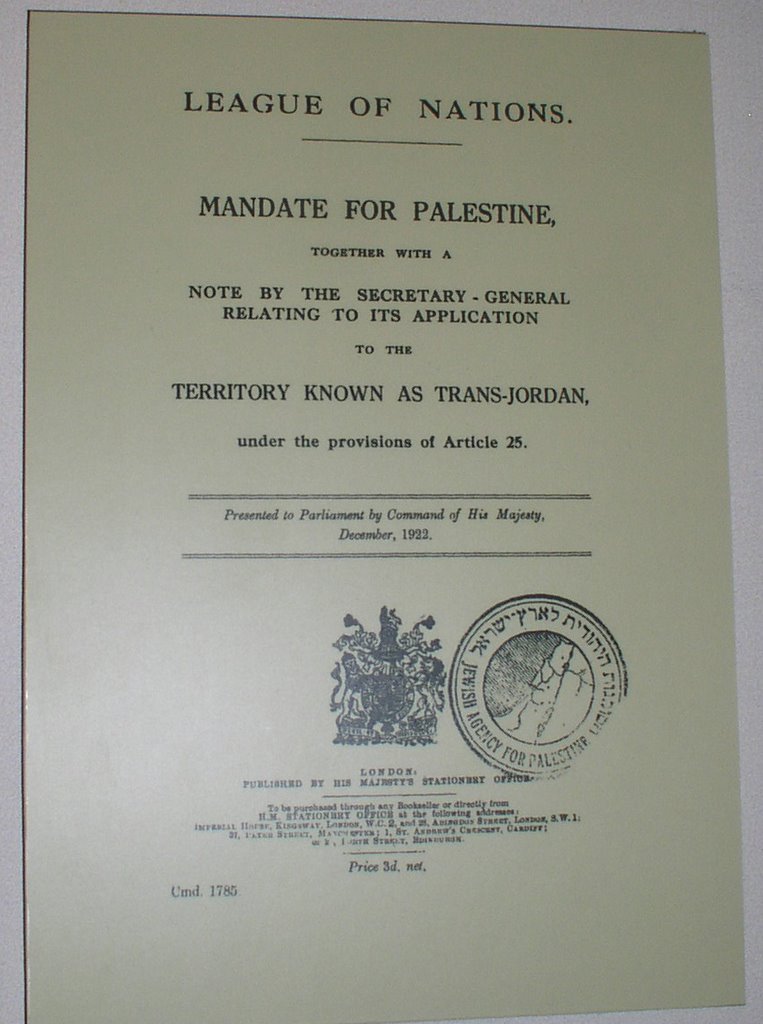
The best I can offer here is a shot of one important historical document displayed in their gorgeous museum area.

At left, the League of Nations Mandate, assigning Palestine ("Trans-Jordan") to Great Britain in December, 1922.

Also on display was the landmark 1994 decision on the El Al Airlines vs. Jonathan Danilowitz case, awarding employee benefits to same-sex life partners. (My photo of that one came out too blurry to post.)

By coincidence, at the Court yesterday they were hearing arguments on whether to recognize same-sex civil marriages performed legally in foreign countries, for example Canada. The lawyer for the state was arguing valiently and energetically against, but the judges (there were seven, including four women and Chief Justice Aharon Barak) were giving her a hard time and I predict she will lose. After the hearings are concluded, they will take a few months to deliberate, so look for a decision this Fall. This case is of personal interest to me, given that elswhere and Renaissance Woman got married in Vancouver, BC, in 2000, two years after their commitment ceremony in the USA. Not that I expect them to move to Israel any time soon, but in theory it would be nice if they could come as a married couple, with whatever benefits that would bestow.

Tel Aviv Kiosk


Tel Aviv Kiosk
Originally uploaded by savtadotty.
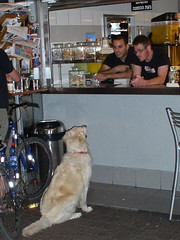
Do you want that cappuccino in a mug or a bowl?

Saturday, May 27, 2006

A U.S Army Tzaddik*?

*The word "tzaddik" literally means "righteous one." The term refers to a completely righteous individual, and generally indicates that the person has spiritual or mystical power. See Judaism 101.

Maybe I exaggerate, but after reading so much negative press about the U.S. Iraq story, it comes as a relief to learn about someone who seems to be able to apply the lessons that Prof. Charles Tilly teaches in the book I haven't read yet, but blogged about anyhow. Colonel H. R. McMaster understands his job in Iraq: to learn how to listen to Iraqi stories. I wish we could clone him so his approach could be scaled up world-wide. Here's a quote that makes me want to enlist:

...Every time you treat an Iraqi disrespectfully, you are working for the enemy," McMaster said he told every soldier in his command. He ordered his soldiers to stop using the term "hajji" as a slang term for all Iraqis, because he saw it as inaccurate and disrespectful...

For more about Col. McMaster's work, read The Washington Post, CBS News 60 Minutes, Newsweek, and The New Yorker magazine. Listening to this 8-minute audio-narrated slide show made me worry whether McMaster's work will take hold, even though it will certainly teach his soldiers something important.

The serious question is: is Iraqi unification possible, or should there be a "three-state-solution:" Kurdistan, Sunnistan, and Shiastan?

The even more serious question is: who gets to decide?

Wednesday, May 24, 2006

Never Apologize, Never Explain

I just read (in the April 10 issue of The New Yorker magazine) Malcolm Gladwell's review of the book Why?, in which Columbia University sociologist Charles Tilly wrote an analysis of the reasons people use to explain events or behavior.

Tilly proposes four basic types of reasons:

conventions (socially accepted clichés like "My train was late," or "We're otherwise engaged that evening")
stories (simplified cause-effect narratives)
codes (legal, religious)
technical accounts (complicated narratives, often impenetrable to nonspecialists).

Tilly believes that social relations dictate the kind of reason people invoke in a given circumstance. For instance, people offer more elaborate rationales for their behavior — stories, rather than conventions — to those close to them. They invoke codes with individuals whom they have power over, but not those who have power over them.

My first question is: what kind of relation is implied when you don't offer any reason at all?

I suspect Tilly's typology currently works for North America, and perhaps for all modernized cultures. As interesting as his theory is though, given the fact that America is involved in world-wide conflicts and diplomacy, I hope some diplomats/cultural anthropologists will take this subject further, to analyze explanations in other cultures.

Which brings me to my second question: what happens if your only explanation tool is the story?

Sitting here in the Middle East, I often find myself trying to decode public statements simply to discover what the underlying agenda could be. Within Israel, the "power distance" is practically non-existent, so almost all behavior is explained with stories. [To traffic cop] "I went through the red light because I'm rushing my wife to the hospital." [To teacher] "My dog ate my homework." [To boss] "I'm late for work because there was a bomb scare on the road." [To child] "God told us/them not to drive on Saturdays."

That last one is a consolidation of all four types, and that's my theory. Our only tool here is The Story. If you're an observant Jew in Israel, everything boils down to the Jewish Story. If you're a non-observant Jew in Israel, everything boils down to the Zionist Story. If you're a non-Jew living in Israel, you have a second-class citizen story or a technical account. Almost all Israeli explanations are stories or occasionally technical accounts. Either because the country is so young, or because it's so tribal, or maybe because it's so post-modern, conventions, laws, and codes - where they exist at all - are turned into stories.

As for the Palestinian Story, it's so intimately connected to the Zionist Story as a negation that I don't think Israelis and Palestinians will be able to get along without war until we can find a way to combine our stories. Two States with a Single Story: is it possible? The immigrant problems in Europe and North America can be explained as: immigrants won't give up their Story.

Who said Life is Not a Novel? Prediction: In the Global Village, all we'll have is blogs and science.

Friday, May 19, 2006

About the Soup Salon

You may have occasionally read one or another Israel-based blogger mention that they were coming over to my house on a Friday afternoon for some soup. That's because I make a batch of soup every week, usually on Thursday, and serve it up to whoever drops by on Friday afternoon. Sometimes there are just four of us, sometimes ten or more. Once (so far) we played Scrabble in Hebrew.

I really enjoy hosting this weekly meet-up for a lot of reasons, not the least of which is that it motivates me to straighten up for "company" at least once a week. Living alone and enjoying it so much, I'm tempted to let things slide and not care about tidiness, but when I have guests, I like to at least make my bed!

But I also enjoy it because it gives me a taste of what it might be like to have my own family living here. The strong local tradition of Friday night family meals is observed by religious and secular alike...in secular families, the younger members often go out to parties, discos, or movies after dining chez mom and pop. The whole routine is feasible thanks to Israel's size: even people who live in a different city from their parents are probably close enough to pop over for a weekend meal without having to stay overnight. So I get a little of the rhythm of family life, even without the family.

Most of my guests do not have much immediate family in Israel. If they did, they'd be busy either preparing or preparing to attend their family dinners, so Friday afternoon is the perfect time for us "loners."

And conversation is fun! Even when we have Hebrew-speakers and have to expose our impoverished vocabularies and feeble grammar skills.

Today's salon was a special treat for me: a four-year-old child attended. With his mother. At least his grandmother lives abroad, ha ha!

Tuesday, May 16, 2006

Blog B'Omer - Too Little, Too Late

I don't really have anything to say about yesterday's holiday, Lag B'Omer, but once I came up with the title for the post, I couldn't hide it under a bushel, could I?

On the other hand I have a lot to say about Mother's Day, but my daughter said it better.

Sunday, May 14, 2006

Are You Happy?

If you are, you can skip this post. If you're not, you can improve your situation for free:

Read this article about Harvard lecturer Tal Ben Shahar in today's Haaretz.

Listen to this radio interview with Tal on NPR. (I love his accent!)

Watch Tal's lectures on video straight from his course web site (click on "Lecture Videos," pick your lecture and wait: they take a while to download).

I discovered that the same thing that makes Tal happy makes me happy:
"...Despite all the problems, we have a wonderful country. Israel is my home and I love the country. When I ask myself what will bring me personal happiness, happiness for my family, the answer is to live in Israel. The Israelis are very authentic. In no other place have I experienced the bond I have with the state and with the people who live in it - and I am not the first Israeli to say this."
Tal is returning to Israel this summer for a year or more.

Thursday, May 11, 2006

I Wanted Saddle Shoes


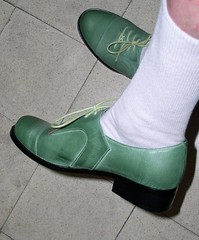
Green Shoes
Originally uploaded by savtadotty.
I got a letter from my alma mater today, announcing preparations for a 50th reunion next year. I remember the school "uniform" most of us seemed to wear back then: white buckskin shoes, bobby sox, skirts, sweaters, and blazers. But I remember more fondly the thrill of new saddle shoes when I went to elementary school. I even found a web site that sells them, both vintage and new. But a shoe in the hand two shoes on the foot is are worth etc., etc., and today while walking my doggie these extraordinary green shoes caught my eye; they were so comfortable I couldn't resist.

I don't think I'll attend that reunion.

Wednesday, May 10, 2006

Use Blog Power

Alaa, a well-known pro-democracy blogger in Egypt, has been arrested and imprisoned by the Egyptian government. Lisa of On the Face covers the story. Lisa also explains how you can help to secure Alaa's freedom, no matter where you live, and I have copied some of the information here from her site.

Global Voices Online manager Rachel Rawlins suggested producing a "Google Bomb," so that people searching for information on Egypt will find the link to the Free Alaa! at the top of the list. Such a bomb does no physical harm to anyone. Here's how it works: write a blog post where you mention Egypt as many times as possible. Every place it occurs, link the word Egypt to the Free Alaa! blog at http://freealaa.blogspot.com/, and you will help push the site higher on the rank of Google searches for Egypt.

Rachel says it will help aggregators (as if we knew what they were) if you:
1) post the word googlebombingforalaa
2) link it to http://technorati.com/tag/googlebombingforalaa
3) so your blog displays googlebombingforalaa

If you don't want to engage in google bombing, at least go to the Free Alaa! blog and find out where to send letters to various governments and non-governmental agencies to protect our right to free speech. It's not to be taken for granted, you know.

Monday, May 08, 2006

Don't be a Stranger!

I've had a site meter for quite some time, just out of curiosity. I blog mostly for myself and my family, and over the year-and-a-half since I started, for my commenters too, some of whom I've even gotten to know IRL. But I suddenly got self-conscious about these readers who never comment, and some of them repeatedly come back for more. Who are you, technology person in Poland? You people in Texas I'm sure I don't know, because I don't know anybody in Texas? And what about you down there in South Africa? Why are you reading and not commenting? Am I scary? Hateful? At least I can be sure it has nothing to do with bad breath.

Friday, May 05, 2006

TA E AWA


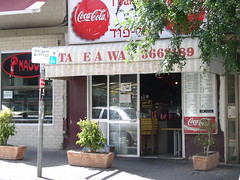
TA E AWA
Originally uploaded by savtadotty.
Whenever I look at this neighborhood Thai food restaurant's awning, Scrabble thoughts come to mind: the "K" is worth 5 points and the "Y" is 2 points. Where did they go?

(The Hebrew letters on the sign, next to the Coca Cola bottle-top, say "Thai-Food")

Wednesday, May 03, 2006

Israel's 58th Independence Day 2006 (5766)

I actually remember that day in May, 1948, because my father was so pleased. He was a man of strong emotionality (bipolar? who knows?) and his anger frightened me terribly, but his tenderness strengthened me and ennobled the idea of a "Man" for me. So I am almost overcome with sentimentality today, saved only by the wry humor of the wonderful book I am reading: Jonathan Safran Foer's Everything is Illuminated. One of my favorite passages so far (I'm on page 200 of the British Penguin edition) is a quotation from The Book of Antecedents, a kind of group blog by the residents of the fictitious shtetl Trachimbod:
Jews Have Six Senses
Touch, taste, sight, smell,hearing...memory. While Gentiles experience and process the world through the traditional senses, and use memory only as a second-order means of interpreting events, for Jews memory is no less primary than the prick of a pin, or its silver glimmer, or the taste of the blood it pulls from the finger. The Jew is pricked by a pin and remembers other pins. It is only by tracing the pinprick back to other pinpricks - when his mother tried to fix his sleeve while his arm was still in it, when his grandfather's fingers fell asleep from stroking his great-grandfather's damp forehead, when Abraham tested the knife point to be sure Isaac would feel no pain - that the Jew is able to know why it hurts.

When a Jew encounters a pin, he asks: What does it remember like?
When I encounter Israel's Independence Day, it remembers like my father's delight.