
Sunday, February 26, 2006
Jet Set Sister
If all goes as planned, my next post will be from LA, where I am travelling tomorrow to celebrate my big bro's 80th birthday. It's a tiny stay for a long trip...be back home in a week.


Friday, February 24, 2006
My Favorite Wedding Story
A very amusing post over at The Ice Floe reminded me of this memory. When you've read them both, you'll understand the connection.
It was a lesbian commitment ceremony in 1998, planned by my daughter elswhere and her partner RW. From far and wide about 100 people were streaming to a beautiful Victorian resort-town near Canada to witness the event. Months of preparation had gone into the event, with not a little trepidation about encountering overt and incipient homophobia.
The ceremony was a rousing success, as was the entire weekend, including the meeting of the two brides' families for the first time, and some family feuds were healed. Throughout all the planning - the invitations, the caterer, the dresses, the rehearsal dinner, the musicians, the program, the vows, the hotel, the photographer, etc., etc. - nobody involved batted an eye that this was for two women (admittedly, it was still the era of "It's the economy, stupid," but still, I was impressed.)
Later elswhere reported this happening after the event:
She and RW stayed on in Victorian Resort Town for a couple of nights to recover from the festivities, and so it wasn't until two days later that they went together to the local rental shop where they had rented various items like chairs and tableware, to settle their account:
RW: "We're here to pay our bill for the Booland wedding."
Saleswoman: "Oh, you're from that wedding over at the Victorian Resort Town Hotel. We heard it was really unusual."
Uh-oh, they thought, here it comes.
RW (cautiously): "In what way?"
They held their breath to prepare themselves for the reply.
Salewoman: "We heard it was a Jewish wedding! With lots of wonderful dancing!"
*****************************************************************************
(And so it was)------------------------->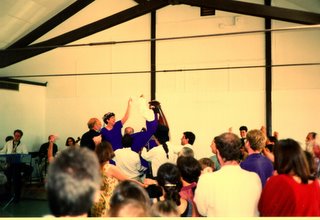
It was a lesbian commitment ceremony in 1998, planned by my daughter elswhere and her partner RW. From far and wide about 100 people were streaming to a beautiful Victorian resort-town near Canada to witness the event. Months of preparation had gone into the event, with not a little trepidation about encountering overt and incipient homophobia.
The ceremony was a rousing success, as was the entire weekend, including the meeting of the two brides' families for the first time, and some family feuds were healed. Throughout all the planning - the invitations, the caterer, the dresses, the rehearsal dinner, the musicians, the program, the vows, the hotel, the photographer, etc., etc. - nobody involved batted an eye that this was for two women (admittedly, it was still the era of "It's the economy, stupid," but still, I was impressed.)
Later elswhere reported this happening after the event:
She and RW stayed on in Victorian Resort Town for a couple of nights to recover from the festivities, and so it wasn't until two days later that they went together to the local rental shop where they had rented various items like chairs and tableware, to settle their account:
RW: "We're here to pay our bill for the Booland wedding."
Saleswoman: "Oh, you're from that wedding over at the Victorian Resort Town Hotel. We heard it was really unusual."
Uh-oh, they thought, here it comes.
RW (cautiously): "In what way?"
They held their breath to prepare themselves for the reply.
Salewoman: "We heard it was a Jewish wedding! With lots of wonderful dancing!"
*****************************************************************************
(And so it was)------------------------->

Sunday, February 19, 2006
I Agree with Francis
From After Neoconservatism by Francis Fukuyama in today's NY Times Magazine:
Radical Islamism is a byproduct of modernization itself, arising from the loss of identity that accompanies the transition to a modern, pluralist society. It is no accident that so many recent terrorists, from Sept. 11's Mohamed Atta to the murderer of the Dutch filmmaker Theo van Gogh to the London subway bombers, were radicalized in democratic Europe and intimately familiar with all of democracy's blessings. More democracy will mean more alienation, radicalization and — yes, unfortunately — terrorism.Loss of identity makes a person dangerous.
Friday, February 17, 2006
Israel's Edit Piaf is Gone
Shoshana Damari's funeral was held today in Tel Aviv.
Her CD's are remarkably expensive at Amazon, but you can hear a clip from her most famous song, Kalaniyot (Anemones), on Track 21 for free. HaKrav haAharon (The Last Battle) (Track 5) is so rousing you'll want to jump up and enlist immediately in the nearest army. Or start your own.
Her CD's are remarkably expensive at Amazon, but you can hear a clip from her most famous song, Kalaniyot (Anemones), on Track 21 for free. HaKrav haAharon (The Last Battle) (Track 5) is so rousing you'll want to jump up and enlist immediately in the nearest army. Or start your own.
Thursday, February 16, 2006
Yom Kippur Any Time
Whenever I catch myself beating myself up about something, I tell myself this story, and it pulls me out of it, even if it's not Yom Kippur:
On Yom Kippur, each Jew in synagogue prays for atonement and beats his breast for his sins against God. He cries for divine forgiveness. He says, "before you, God, I am nothing. I am nobody."
One Yom Kippur Mr. Goldberg, a pillar of the community, goes into the synagogue. As he heads through the entrance hall, he passes Mr. Horowitz right there, praying and wailing loudly and pitifully.
Goldberg: "Come into the sanctuary to pray with us."
Horowitz: "I am too unworthy to be in the same room with everyone else."
While Goldberg frowns over this answer, his neighbor Mr. Schwartz enters the lobby. Goldberg says to Schwartz, pointing to Horowitz, "Look who thinks he's nobody!"
Tuesday, February 14, 2006
Art Meets Life But is it Art?
In a recent issue of the NYTimes, the cartoon controversy found its way into the Arts section. The article ended with the following sentence:
To many people, pictures will always, mysteriously, embody the things they depict.I am not happy about that "mysteriously" adjective. It is as unenlightening as saying that words "mysteriously" embody things to many people, even words published in the New York Times. Plenty of research has been done on perception, magic, art, symbols, semiotics, and all forms of human communication. The embodiment is not unfamiliar, or we wouldn't bother to carry pictures of our loved ones around with us and even display them on our desks.
Suppose you object and say "But those are photographs! They are different from the distortions imposed by cartoonists or abstract painters! I offer you two examples:
A wealthy businessman, let's call him Monsier Armand, commissioned Picasso to paint a portrait of Madame Armand. After many sittings, M. Armand was invited to view Picasso's progress. The painting had one eye facing front, another in profile, and the rest of the portrait was similarly cubistically rendered. M. Armand was a stolid, literal-minded kind of guy, so he complained to Picasso, "That doesn't look like my wife! That is not Mme. Armand!"
Picasso was long-experienced in dealing with literal-minded types, and so he asked M. Armand "What does your wife really look like?" In frustration, M. Armand sputtered and took a snapshot of Mme. Armand out of his billfold and showed it to Picasso. Picasso took the photo in his hands and with feigned interest turned in first one way and then another and finally handed the photo back to M. Armand, saying, "Small, isn't she?
The other example is the famous realistic painting by Magritte, representing a pipe. The title is Ceci n'est pas un pipe, translation, This is Not a Pipe.
While on the subject of art, don't worry about The Scream. The famous missing painting will be found: our best people have started working on it.
Monday, February 13, 2006

The Third Ear
I have another post ready, but Blogger won't let me post it, so I thought I'd try posting from Flickr.
This is where I rent my videos. They moved from their former rabbit-warren premises about six months ago. The move made me sad, because now they're 15 minutes' walk away, instead of 5.
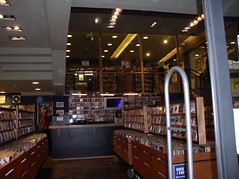
This is where I rent my videos. They moved from their former rabbit-warren premises about six months ago. The move made me sad, because now they're 15 minutes' walk away, instead of 5.
Wednesday, February 08, 2006
Human Ecology (Updated)
I've been reading Ronni Bennett's blog, Time Goes By which focuses on ageism in America. Then today I read Tamar's post at Tamarika, on how she misses small children in her life.
These got me to thinking about the waste that consumer societies can create, and how the ecology awareness has risen: the Green movement, recycling, reusing, simplifying life, etc. But having worked all my adult life in the knowledge industry, I have an interest in something that ecology movements seem to ignore: consumer societies waste knowledge more than the third world does. I'm not talking about knowledge that became obsolete, like how to drive a horse-and-buggy, or even modern knowledge like how to use html, or what's your Congressman's name, or who won last year's SuperBowl or knowledge tools like reading, writing, 'rithmetic, and googling. I'm talking about serious knowledge that could more properly be called wisdom. How do consumer societies create, distribute, and conserve wisdom?
Well, where does wisdom come from? Experience. And who has the most experience? Old people. Not that all old people are wise, but wisdom is concentrated in the elderly. So if wisdom is valuable, then old people pretty much control a social resource. True they have more medical needs than young, and they may produceless fewer material goods. But they we have something of value in exchange. Now here is a little survey: how much of your time outside the office or the classroom did you spend last week talking with someone a generation older than you? I'll even cut you some slack and whittle it down to someone 15 years older or more?
My life has been made incredibly richer because I got to be with old relatives often. It was easy: they lived in the same city. Then my mother came to spend the last years of her life in my house. Which turned out to be 21 months, but we didn't know that at the time. In Israel, I've befriended a woman 18 years my senior who lives nearby, so I can visit her regularly and hear tales of her youth and get her take on current events. I consider these "win-win" visits, not obligations, because of her sensible approach to life, honed over 60 years' living in the same apartment! I know that any visit could be the last. With greater probability than visiting a younger person.
It's so much easier for multi-generational families to be together often in Israel, because the country is small enough no matter where you live in it. And people don't move as often as American do, so roots can grow deeper. The "generation gap" simply does not exist, except in a clothing shop. Some young people party late into the night on weekends, but TV commercial scenarios, a pretty accurate reflection of social conventions, often include infants, small children, and elderly people interacting with the beautiful youth. These indirect messages make me feel less marginalized and more valued here than I do on my visits to the USA (not talking about my immediate family, but the general public I may encounter along the way).
About six years ago, I stopped at a Tel Aviv gas station to fill up the tank. The attendant smiled at me and asked, "What'll it be, savta?" [note for my new readers: that's "grandma" in Hebrew.] I realized he was being genuinely friendly, not at all insulting or mocking. I was proud too, 'cause elswhere and Renaissance Woman were about to make me a real savta. I bet he got to see his own savta often, for Wisdom Transfer Sessions, although they may have called them "meals."
***************************************************************
(Update)
I seem to have reverted to an admiration of the Oral Tradition in this post. I suppose there is wisdom to be found in (some) books too, but then there's no feedback. Could this be why the Self-Help and How-To genres have become so popular? Learning how to live has been reduced to something like the difference between learning to cook from a book or from a chef. Why not both?
These got me to thinking about the waste that consumer societies can create, and how the ecology awareness has risen: the Green movement, recycling, reusing, simplifying life, etc. But having worked all my adult life in the knowledge industry, I have an interest in something that ecology movements seem to ignore: consumer societies waste knowledge more than the third world does. I'm not talking about knowledge that became obsolete, like how to drive a horse-and-buggy, or even modern knowledge like how to use html, or what's your Congressman's name, or who won last year's SuperBowl or knowledge tools like reading, writing, 'rithmetic, and googling. I'm talking about serious knowledge that could more properly be called wisdom. How do consumer societies create, distribute, and conserve wisdom?
Well, where does wisdom come from? Experience. And who has the most experience? Old people. Not that all old people are wise, but wisdom is concentrated in the elderly. So if wisdom is valuable, then old people pretty much control a social resource. True they have more medical needs than young, and they may produce
My life has been made incredibly richer because I got to be with old relatives often. It was easy: they lived in the same city. Then my mother came to spend the last years of her life in my house. Which turned out to be 21 months, but we didn't know that at the time. In Israel, I've befriended a woman 18 years my senior who lives nearby, so I can visit her regularly and hear tales of her youth and get her take on current events. I consider these "win-win" visits, not obligations, because of her sensible approach to life, honed over 60 years' living in the same apartment! I know that any visit could be the last. With greater probability than visiting a younger person.
It's so much easier for multi-generational families to be together often in Israel, because the country is small enough no matter where you live in it. And people don't move as often as American do, so roots can grow deeper. The "generation gap" simply does not exist, except in a clothing shop. Some young people party late into the night on weekends, but TV commercial scenarios, a pretty accurate reflection of social conventions, often include infants, small children, and elderly people interacting with the beautiful youth. These indirect messages make me feel less marginalized and more valued here than I do on my visits to the USA (not talking about my immediate family, but the general public I may encounter along the way).
About six years ago, I stopped at a Tel Aviv gas station to fill up the tank. The attendant smiled at me and asked, "What'll it be, savta?" [note for my new readers: that's "grandma" in Hebrew.] I realized he was being genuinely friendly, not at all insulting or mocking. I was proud too, 'cause elswhere and Renaissance Woman were about to make me a real savta. I bet he got to see his own savta often, for Wisdom Transfer Sessions, although they may have called them "meals."
***************************************************************
(Update)
I seem to have reverted to an admiration of the Oral Tradition in this post. I suppose there is wisdom to be found in (some) books too, but then there's no feedback. Could this be why the Self-Help and How-To genres have become so popular? Learning how to live has been reduced to something like the difference between learning to cook from a book or from a chef. Why not both?
Sunday, February 05, 2006
M & M's Commercial?
Busy bat
Video sent by savtadotty
Do you think the M & M's candy people would use it as a commercial? The big royalties and residuals could go into Little Bear's college fund.
Friday, February 03, 2006
Denmark


 Violence doesn't need translation.
For more languages, see http://skender.be/supportdenmark/
Thanks to another blogging relative for this!
Thursday, February 02, 2006
My Google Has a Bug
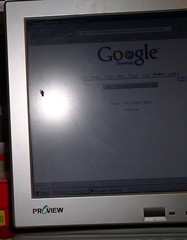
There was warm weather. In came a computer-loving fly. I wonder what he was searching for? Probably "tse tse."
Subscribe to:
Posts (Atom)