Having been summoned by my hateful bank to sign something thanks to the new laws about credit lines, I found myself in Ramat Aviv. Yes, I am getting revved up to move bank accounts, but the stars are not quite aligned properly yet. So what to do after The Signing but trot over to the Mall to check out the movie situation. Sure enough, Prairie Home Companion was just about to start, so in I went. I hadn't read any reviews of it, and I still haven't, so it was a "pure" first-hand experience.
Any movie with Kevin Kline, Meryl Streep, Lili Tomlin, and Garrison Keeler, can't be terrible, no matter who's directing and what the script is. Especially when it turns out that three of them (Kevin doesn't get a chance) can sing. Director Robert Altman seemed to have a taken a dose of Woody Allen on downers, so I could never be sure whether the film was a spoof, a dark comedy, or just a romp. The plot lurched along from musical number to musical number, the way Broadway musicals used to do in the 1950's, and kind of the way the radio show of the same name did back in the 1980's. I give it three stars out of a possible five: entertaining, but not memorable.
*(Update)
I just found my diary from age 10. This week at age 10 I went to the movies and saw "The Perils of Pauline" with Betty Hutton (no, not the silent one). After school this week I went to a Girl Scout meeting, two Halloween parties, the dentist, and a sewing lesson. I think I walked to these events. The sewing lessons came with my Mom's new Singer. I was making myself a dress. With bound buttonholes.

Tuesday, October 31, 2006


Friday, October 27, 2006
Last Night
I went to a recital and heard Sharon Rostorf-Zamir sing Schubert lieder; I'm still swooning. She is really good.
Thursday, October 26, 2006
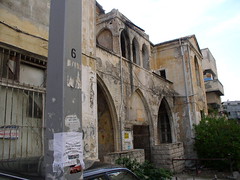
I Love This Wreck
Why do I love these wrecks? Maybe because they're older than I am and compared to them, I'm in pretty good shape!
Monday, October 23, 2006
Life is With People*
One evening last week I took a train home from Hertzlia. The timetable said the train would depart at 9:50, and I got to the station at 9:30, in plenty of time. I was prepared with magazine to read while waiting. Also on the platform was a lovely young woman (LYW) with a small dog, a soldier, and a couple of kippa-wearing young men (KWYM) carrying briefcases and chatting together on the bench we all shared. Five minutes later, a decent-looking fellow (DLF) in his 40's arrived.
After a few minutes of impatient pacing in front of us, DLF walks over to KWYM and politely but quite loudly asks them in Hebrew if they would please answer a question: how could it be that God knows everything and still could or would give men free will? Because it just didn't make any sense to him. How could a man have free will and yet God would know in advance what he was going to do? What was free about that?
The assembled group is stunned. Is this man a nut? Who else would ask perfect strangers such a serious and deep question? But he seems rational, respectful even, clean, not drunk or stoned. KWYM #1 replies a bit defensively that he is not a rabbi, that this is a question that requires a rabbi to deal with. We're all a little disappointed at his cop-out.
DLF was not to be discouraged and repeated his question, becoming slightly more irritated with KWYM for not giving him a satisfactory answer, and looking around to us for encouragement. I was barely following the Hebrew and fascinated. The LYW was smiling, obviously enjoying the back-and-forth, but not about to get swept up into the conversation. The small dog went into hiding under our bench.
KWYM #1 repeatedly insisted that a rabbi was required, and looked around desperately for one to appear. Miraculously, when we weren't looking another KWYM, #3,had sat down behind us, so #1 tapped on #3's shoulder, hoping he would turn around and supply an answer. We were all waiting to hear the reply of KWYM #3, but instead of any wise words, #1 recognized #3 as an old yeshiva classmate of his and there followed the conversation one has when one bumps into an old yeshiva classmate (I imagine): How are you? What are you doing now? Are you married yet? (No) How is so-and-so, our mutual friend, etc. etc.
Meanwhile KWYM #2 decides to make a call on his cellphone. I'm hoping he's calling his rabbi to get an urgent answer to DLM's question, but he's just calling home to tell them to save him some food, he's very hungry.
By this time 9:50 has come and gone, and no train has appeared. At 10:00 a train approaches in and whizzes by...an express, not stopping. By 10:05 DLM has abondoned the free will question and announces a little-known fact: if the train is 20 or more minutes late we are entitled to a full refund on our tickets, which he learned from his wife who works for the railroad, but don't tell anyone how we found out this secret because he doesn't want his wife to get in trouble. No one leaves to get a refund.
Finally, at 10:15, our train pulls in. Our little group disbands, without ever finding out why God gave man free will. But for 45 minutes my magazine went unread.
*Somebody - was it Sholom Aleichem? - said this about life in the shtetl.
After a few minutes of impatient pacing in front of us, DLF walks over to KWYM and politely but quite loudly asks them in Hebrew if they would please answer a question: how could it be that God knows everything and still could or would give men free will? Because it just didn't make any sense to him. How could a man have free will and yet God would know in advance what he was going to do? What was free about that?
The assembled group is stunned. Is this man a nut? Who else would ask perfect strangers such a serious and deep question? But he seems rational, respectful even, clean, not drunk or stoned. KWYM #1 replies a bit defensively that he is not a rabbi, that this is a question that requires a rabbi to deal with. We're all a little disappointed at his cop-out.
DLF was not to be discouraged and repeated his question, becoming slightly more irritated with KWYM for not giving him a satisfactory answer, and looking around to us for encouragement. I was barely following the Hebrew and fascinated. The LYW was smiling, obviously enjoying the back-and-forth, but not about to get swept up into the conversation. The small dog went into hiding under our bench.
KWYM #1 repeatedly insisted that a rabbi was required, and looked around desperately for one to appear. Miraculously, when we weren't looking another KWYM, #3,had sat down behind us, so #1 tapped on #3's shoulder, hoping he would turn around and supply an answer. We were all waiting to hear the reply of KWYM #3, but instead of any wise words, #1 recognized #3 as an old yeshiva classmate of his and there followed the conversation one has when one bumps into an old yeshiva classmate (I imagine): How are you? What are you doing now? Are you married yet? (No) How is so-and-so, our mutual friend, etc. etc.
Meanwhile KWYM #2 decides to make a call on his cellphone. I'm hoping he's calling his rabbi to get an urgent answer to DLM's question, but he's just calling home to tell them to save him some food, he's very hungry.
By this time 9:50 has come and gone, and no train has appeared. At 10:00 a train approaches in and whizzes by...an express, not stopping. By 10:05 DLM has abondoned the free will question and announces a little-known fact: if the train is 20 or more minutes late we are entitled to a full refund on our tickets, which he learned from his wife who works for the railroad, but don't tell anyone how we found out this secret because he doesn't want his wife to get in trouble. No one leaves to get a refund.
Finally, at 10:15, our train pulls in. Our little group disbands, without ever finding out why God gave man free will. But for 45 minutes my magazine went unread.
*Somebody - was it Sholom Aleichem? - said this about life in the shtetl.
Saturday, October 21, 2006
A (Not Very) Coded Message to Doc Alphabet
Dear Doc Alphabet,
I don't think it's fair to Spanglemonkey to always use her as our channel of communication, so I'm inviting you directly to a Soup Salon (group, Friday afternoons) or a piece of homemade pecan pie entre nous. You two are invited too - Jo and Manny - even though Jo gets chicken soup only. Toughlove.
לשנה הבאה בתל אביב
Shalom שלום,
Savta Dotty
I don't think it's fair to Spanglemonkey to always use her as our channel of communication, so I'm inviting you directly to a Soup Salon (group, Friday afternoons) or a piece of homemade pecan pie entre nous. You two are invited too - Jo and Manny - even though Jo gets chicken soup only. Toughlove.
לשנה הבאה בתל אביב
Shalom שלום,
Savta Dotty
Wednesday, October 18, 2006
Click Here
You know you're spending too much time on the Internet when you read a magazine article with your breakfast and find your fingers poking some underlined text and you wonder why nothing is happening.
Tuesday, October 17, 2006
Laundry, a Treatise
Over the years, I have practiced just about every form of laundry, including washing it by hand at the local stream during a wonderful summer bicycling in France 50 years ago.
Laundry is such a good socio-economic barometer I am amazed that it hasn't received more attention, an omission I hope to rectify with this little essay. Tell me who does your laundry and where, and your geographic, social, and economic positions are revealed.
Apart from my summer in France, my laundry was always done indoors. That is, the washing part was an indoor affair. The drying was done outdoors during my childhood because, at first, we didn't own a dryer, and later, because my mother believed that sunshine did a better job. She may have also been pleased to have an excuse to visit our back yard, because she was not into gardening. I was allowed to hand her clothespins when I couldn't reach anything else. Even now, in Israel the sun is also used for drying clothes by many middle-class people for economic, ecological or habitual reason. Given the local climate, hanging laundry outdoors certainly makes sense, although some upscale apartment buildings here do prohibit external laundry lines now. Very snobby. The most sensible new buildings confine the laundry lines to off-street windows, barricaded behind "modesty panels."
But hanging laundry to dry does take more time than throwing it into the dryer, and anyone who lived or lives in a "time is money" culture as I did can't imagine life without a dryer. Which is why I brought one with me when I immigrated, thus labeling me forever in the eyes of the natives as a typical spoiled rich American. Never mind that in the interim, many Israeli homes now include a dryer…they didn't so much when I first arrived, another indicator that the Israeli pioneer era is passing.
When I was a girl, Marie came to help my mother clean the house. Marie also did the ironing, but I suspect she wasn't allowed near the washing machine. Machines of any kind were worshipped in my house, and as a family we were dedicated to their proper operation and maintenance. Partly out of respect for my father's profession (he was a tool and die man), partly out of respect for the labor it would save my saintly mother, and partly out of pure esthetics, each new appliance was taken to represent a triumph of modern technology and was accorded a place of honor in our household. I suspect the iron was old-fashioned enough to slip into the status of the vacuum cleaner, the other household machine Marie was allowed to operate.
When I moved into my first apartment, there was a decision to be made. Not what washing machine to buy – the apartment was a studio and there was no place to put one – but whether to do the laundry in the basement, where there were machines for that purpose, or to take it to the Laundromat. The basement was cheaper and more convenient on rainy days, so that's where I went. It wasn't until I moved into a more spacious apartment, married and pregnant, that we acquired our own electric washer. I still used the basement dryer though, and a variety of drying racks in the laundry room. The arrival of child #2 coincided with the purchase of our dryer, completing our entry into the middle class. Or so I thought.
But laundry doesn't automatically sort itself and start washing itself as it becomes soiled. Before that happens there is a period of time when it occupies some space outside the washer: on the floor or out of sight in some kind of laundry container. Aha. That's where I've been heading all along. To laundry bags and laundry hampers.
The house, having been built in the 1930's, had a basement containing double laundry sinks and plumbing from the pre-machine washing era. Next to said sinks became the logical place for the installation of the washer and dryer. The door to the basement stairs became a laundry chute, so the laundry used to live at the foot of the basement stairs until laundry day. No need for laundry hampers or laundry bags, as long as someone remembered to scoop up the dirty clothes and toss them down those stairs. The first laundry bag was acquired, and suitably named-taped, when the first child went to sleepaway camp.
My subsequent "empty-nest" abodes were built in the 1980's, and had marvelous laundry systems upstairs, next to the bedrooms! Once again, the laundry could be hidden away from sight in those handy laundry niches. So luxurious, for a single person to have private laundry facilities. I vowed never to go back to collectivist laundry. Hence my decision to import the machines in when I immigrated in 1988.
However, my Tel Aviv apartment did not have a laundry room. Or even the traditional laundry balcony, although the remnants of one can still be found outside the machsan window. The machines were installed in a convenient niche in the bathroom. This being an older apartment, the bathroom is a separate room from the toilet room; otherwise that bathroom niche could be occupied by a toilet. It really is more convenient to have two rooms for the two different functions, especially when the apartment has more than one occupant.
So where does the dirty laundry live? Until last week, it lived in the laundry bag, one of the very same name-taped ones from the 1970's. No one can accuse me of extravagance, at least not in the laundry department.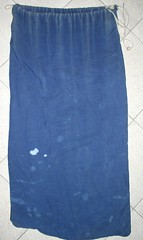
But last week, after a few months of vague laundry-discomfort during which I felt I had reached a stage of life that deserved a proper hamper, I found the perfect one! It fit the space available, its capacity was appropriate to the frequency of my washing-machine operation, and the design made exactly the statement I want to make: here lives a solid, practical, and artistic person!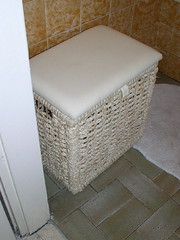 Not some insecure nouveau-riche who needs a designer label on every item in her home to prove she exists; not some hippy slob who throws clothes anywhere just to epater les bourgeois; not some long-overgrown camp child; in short, a grandma!
And if that's not enough to satisfy your interest in laundry, you can click on the last two photos and see them in Flickr, where they have notes! I'm really into this subject today!
Technical help request: how do I get the text to flow around the last two photos?
Laundry is such a good socio-economic barometer I am amazed that it hasn't received more attention, an omission I hope to rectify with this little essay. Tell me who does your laundry and where, and your geographic, social, and economic positions are revealed.
Apart from my summer in France, my laundry was always done indoors. That is, the washing part was an indoor affair. The drying was done outdoors during my childhood because, at first, we didn't own a dryer, and later, because my mother believed that sunshine did a better job. She may have also been pleased to have an excuse to visit our back yard, because she was not into gardening. I was allowed to hand her clothespins when I couldn't reach anything else. Even now, in Israel the sun is also used for drying clothes by many middle-class people for economic, ecological or habitual reason. Given the local climate, hanging laundry outdoors certainly makes sense, although some upscale apartment buildings here do prohibit external laundry lines now. Very snobby. The most sensible new buildings confine the laundry lines to off-street windows, barricaded behind "modesty panels."
But hanging laundry to dry does take more time than throwing it into the dryer, and anyone who lived or lives in a "time is money" culture as I did can't imagine life without a dryer. Which is why I brought one with me when I immigrated, thus labeling me forever in the eyes of the natives as a typical spoiled rich American. Never mind that in the interim, many Israeli homes now include a dryer…they didn't so much when I first arrived, another indicator that the Israeli pioneer era is passing.
When I was a girl, Marie came to help my mother clean the house. Marie also did the ironing, but I suspect she wasn't allowed near the washing machine. Machines of any kind were worshipped in my house, and as a family we were dedicated to their proper operation and maintenance. Partly out of respect for my father's profession (he was a tool and die man), partly out of respect for the labor it would save my saintly mother, and partly out of pure esthetics, each new appliance was taken to represent a triumph of modern technology and was accorded a place of honor in our household. I suspect the iron was old-fashioned enough to slip into the status of the vacuum cleaner, the other household machine Marie was allowed to operate.
When I moved into my first apartment, there was a decision to be made. Not what washing machine to buy – the apartment was a studio and there was no place to put one – but whether to do the laundry in the basement, where there were machines for that purpose, or to take it to the Laundromat. The basement was cheaper and more convenient on rainy days, so that's where I went. It wasn't until I moved into a more spacious apartment, married and pregnant, that we acquired our own electric washer. I still used the basement dryer though, and a variety of drying racks in the laundry room. The arrival of child #2 coincided with the purchase of our dryer, completing our entry into the middle class. Or so I thought.
But laundry doesn't automatically sort itself and start washing itself as it becomes soiled. Before that happens there is a period of time when it occupies some space outside the washer: on the floor or out of sight in some kind of laundry container. Aha. That's where I've been heading all along. To laundry bags and laundry hampers.
The house, having been built in the 1930's, had a basement containing double laundry sinks and plumbing from the pre-machine washing era. Next to said sinks became the logical place for the installation of the washer and dryer. The door to the basement stairs became a laundry chute, so the laundry used to live at the foot of the basement stairs until laundry day. No need for laundry hampers or laundry bags, as long as someone remembered to scoop up the dirty clothes and toss them down those stairs. The first laundry bag was acquired, and suitably named-taped, when the first child went to sleepaway camp.
My subsequent "empty-nest" abodes were built in the 1980's, and had marvelous laundry systems upstairs, next to the bedrooms! Once again, the laundry could be hidden away from sight in those handy laundry niches. So luxurious, for a single person to have private laundry facilities. I vowed never to go back to collectivist laundry. Hence my decision to import the machines in when I immigrated in 1988.
However, my Tel Aviv apartment did not have a laundry room. Or even the traditional laundry balcony, although the remnants of one can still be found outside the machsan window. The machines were installed in a convenient niche in the bathroom. This being an older apartment, the bathroom is a separate room from the toilet room; otherwise that bathroom niche could be occupied by a toilet. It really is more convenient to have two rooms for the two different functions, especially when the apartment has more than one occupant.
So where does the dirty laundry live? Until last week, it lived in the laundry bag, one of the very same name-taped ones from the 1970's. No one can accuse me of extravagance, at least not in the laundry department.
But last week, after a few months of vague laundry-discomfort during which I felt I had reached a stage of life that deserved a proper hamper, I found the perfect one! It fit the space available, its capacity was appropriate to the frequency of my washing-machine operation, and the design made exactly the statement I want to make: here lives a solid, practical, and artistic person!
Not some insecure nouveau-riche who needs a designer label on every item in her home to prove she exists; not some hippy slob who throws clothes anywhere just to epater les bourgeois; not some long-overgrown camp child; in short, a grandma!And if that's not enough to satisfy your interest in laundry, you can click on the last two photos and see them in Flickr, where they have notes! I'm really into this subject today!
Technical help request: how do I get the text to flow around the last two photos?
The Manager's Chair
In one of my previous lives I had a responsible well-paid job at Very Impressive Consulting Company (VICC). What I was doing for them isn't relevant to this story, but I worked in central headquarters. This means I was not actually out in the trenches billing clients by the hour, but was costing the firm big bucks. VICC was organized as a large partnership, not a publicly-owned corporation, so my salary was actually costing the partners a (small) percentage of their income, not contributing directly to it the way the consultants and their managers were.
The partner who hired me knew that what I was doing would become valuable, so meanwhile, in order to convince his greedy partners he had to give me a worthy title. The titles went down the chain: Partner, Director, Manager, Consultant. In the culture of VICC, which was very stodgy, partners would talk only to other partners or directors at headquarters, so I was hired in as a Director.
The fact that I was directing nobody except myself didn't matter. Once I had the title Director on my business card, and the office to go with it, partners would talk to me. And hopefully also listen. As it developed, some did and some didn't. But along with the office came The Furniture. VICC had policies on just about everything, including what kind of furniture you could have in your office. A Partner got Partner furniture, including a leather-upholstered high-backed chair, and a Director got Director furniture, with the same high-backed chair upholstered in fabric. It happened that I hated sitting in the high-backed chair because it hurt my neck. So I told the Person in Charge of Furniture that I wanted a Manager's chair, which was not so high-back and didn't hurt my neck. The Person in Charge of Furniture was taken aback (hah!). Then argumentative. But not himself a Director, so not too argumentative. After all, rank has its privilege.
After a few days' of "thinking it over," the Person in Charge of Furniture proposed a compromise: I could have a Manager's chair in Partner's leather upholstery, the only such chair in the history of VICC. And that's where I sat until I left.
I wonder who got it after me?
The partner who hired me knew that what I was doing would become valuable, so meanwhile, in order to convince his greedy partners he had to give me a worthy title. The titles went down the chain: Partner, Director, Manager, Consultant. In the culture of VICC, which was very stodgy, partners would talk only to other partners or directors at headquarters, so I was hired in as a Director.
The fact that I was directing nobody except myself didn't matter. Once I had the title Director on my business card, and the office to go with it, partners would talk to me. And hopefully also listen. As it developed, some did and some didn't. But along with the office came The Furniture. VICC had policies on just about everything, including what kind of furniture you could have in your office. A Partner got Partner furniture, including a leather-upholstered high-backed chair, and a Director got Director furniture, with the same high-backed chair upholstered in fabric. It happened that I hated sitting in the high-backed chair because it hurt my neck. So I told the Person in Charge of Furniture that I wanted a Manager's chair, which was not so high-back and didn't hurt my neck. The Person in Charge of Furniture was taken aback (hah!). Then argumentative. But not himself a Director, so not too argumentative. After all, rank has its privilege.
After a few days' of "thinking it over," the Person in Charge of Furniture proposed a compromise: I could have a Manager's chair in Partner's leather upholstery, the only such chair in the history of VICC. And that's where I sat until I left.
I wonder who got it after me?
Friday, October 13, 2006
Sushi!


 Ms. 14 came for a visit to Tel Aviv today, and gave me a most satisfactory sushi lesson:
 Step One was going to the Shuk HaCarmel in search of the right store, and I spotted it just as I was buying cucumbers. At the Tel Aviv Far Eastern Market (according to their bag, they have a Jerusalem branch)I bought nori, wasabi, a sushi rolling mat, and the piece de resistence, frozen raw red tuna.
Step Two was making rice according to this Internet recipe, and letting the fish defrost. It took about 1/2 hour. While the rice was cooking, I cut the fish, avocado, and tuna into strips as directed by Ms. 14.
For Step Three, Ms. 14 took over and laid out the ingredient in their proper proportions and positions, allowing an empty margin of nori at the near and the far edges for "gluing" the roll together at the end of the next step.
Step Four was rolling and moistening the far edge of the nori so it would stick to the near edge.
Step Five was cutting the roll into serving-size pieces and arranging them tastefully on the wrong kind of plate (round). I don't have any square or rectangular Japanese dishes. Yet. But I do have a Japanese knife that I've used and treasured for 20 years! Amazingly, about 10 years ago my painter's assistant decided to use it as a screwdriver, and even more amazingly, the painter had it repaired and the assistant called me to apologize.
Step Six was stuffing ourselves with sushi, dipped in wasabi and soy sauce. Next time - and there will be a next time (tfu, tfu, tfu) - I'll buy some Kirin beer at that Far Eastern Market.
Monday, October 09, 2006
A Skirt of Many Colors
 So my friend R. asked me to accompany her on an upper-Dizengoff Street shopping trip and prevent her from spending too much money. I ended up spending five times as much as she did, but I got the skirt of a lifetime. You can see more traditional photos of the skirt at flickr.
Saturday, October 07, 2006
JNF Boxes
Tel Aviv had penguins a few years ago and bulls last year, now we have the Jewish National Fund's charity box, re-scaled to 1.4 meters (4.59-feet) high and redesigned by Israeli artists, displayed on Rothschild Boulevard. The boxes are sponsored by commercial companies, and will be sold in a public auction. Proceeds will go toward rehabilitating forests in the North of the country, damaged during the recent war with Hizbollah. If you want to contribute, www.jnf.org will probably let you.
For more photos of the Rothschild Blvd. boxes, look at my flickr page.
Andas soon as I can figure out how to add it, here's a photo of my own personal JNF box, stolen from my children.

For more photos of the Rothschild Blvd. boxes, look at my flickr page.
And
Returning Home to the 1930's
I've completed my homemaking job at the dascha, and returned home to Tel Aviv. It occurs to me that I've now lived in the same place for 17 years, longer than I lived anywhere else, having gone off to college at the tender age of 16. But the home I often think I'm returning to is the one in the photo, because that's the place I spent raising my children. The house had my three dream features: a fireplace, an attic, and windows on all four sides. Strangely, because of its cookie-cutter "design" (I suspect it wasn't designed at all, back in 1935, but "just growed" at the the builder's whim) my current apartment also has windows on all four sides, although one of them is a tiny window in the bathroom. No attic, and no fireplace, though: they are rare architectural anomalies in Israel.
The tudor-style house pictured was a treasure of fine building materials commonly used in the late 1930's in America's Northeastern suburbs: six-panel wooden doors everywhere, brindle brick, casement windows, parquet floors, copper pipes.
It's a funny coincidence: the three places I've lived in longest - my childhood home, my children's childhood home, and my home in Israel - were all built at around the same time, although the materials are far from similar.
Do you have a favorite decade for your home?
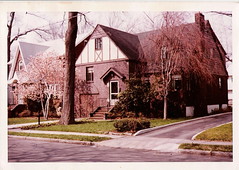
The tudor-style house pictured was a treasure of fine building materials commonly used in the late 1930's in America's Northeastern suburbs: six-panel wooden doors everywhere, brindle brick, casement windows, parquet floors, copper pipes.
It's a funny coincidence: the three places I've lived in longest - my childhood home, my children's childhood home, and my home in Israel - were all built at around the same time, although the materials are far from similar.
Do you have a favorite decade for your home?
Thursday, October 05, 2006
Dascha Chapter Ended

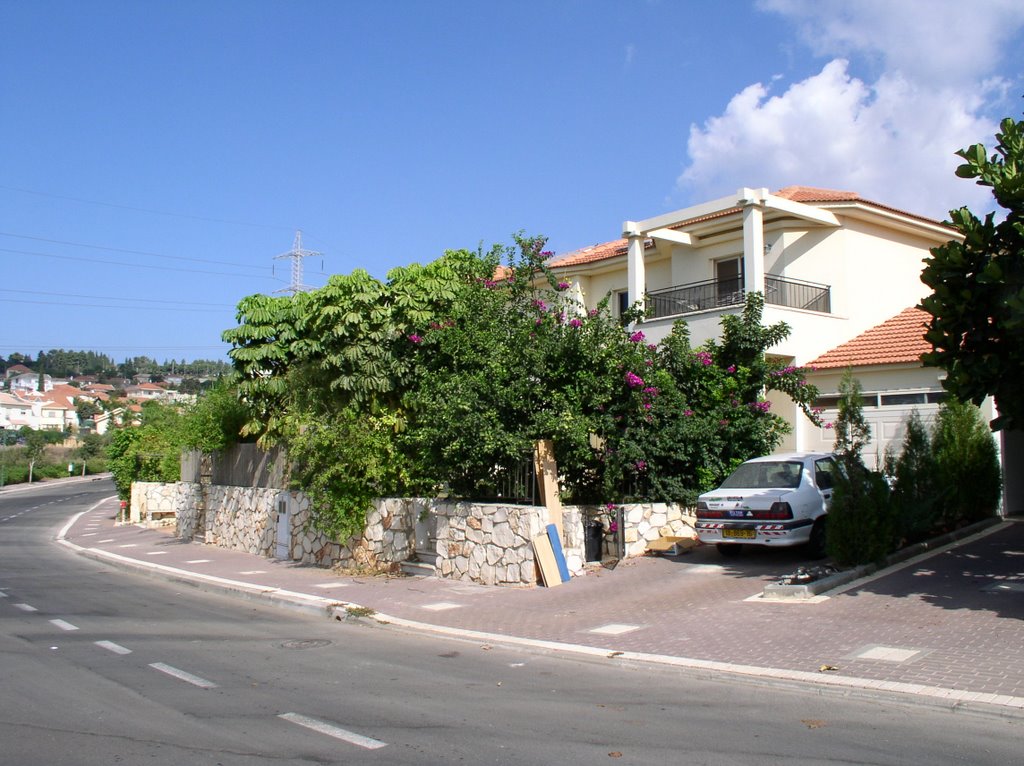
 When the computer died, it was definitely time for me to leave. Luckily the head of the household returned on schedule, with a suitcase full of loot for the girls.
 Please excuse the poor quality of the people-photo: I think the girls took it with a web camera (I wasn't looking). The cat, Jiji, is a very, very mellow boy cat, about 8 months old. My dog (12 years) almost plays with him, which is a first for her...she doesn't know how to play with animals.
Doesn't the dascha look good? If you look closely, you will see shoes carefully placed in the entrance hall for maximum tripping potential. (So happy to be home again!)
Tuesday, October 03, 2006
Trouble in Paradise
I decided to do laundry last night. Big mistake. The electrical system of the house seems to have a big grudge against the washing machine, and the circuit-breaker kept breaking. Then it required a ten-minute rest before I could reset it. The next-door neighbor works for the Electric Company (and, according to unreliable nine-year-old gossip, gets unlimited free electricity as an employment benefit), but hasn't yet found time to stop by. Meanwhile, lurching through three loads of laundry has taken about 24 hours.
AND, something about the sink drain is very sick. The dishwasher is not hooked up, so I wash the dishes by hand (how primitive!) But the water goes down the drain and seems to flood under the sink.
Arrrggggh!
AND, something about the sink drain is very sick. The dishwasher is not hooked up, so I wash the dishes by hand (how primitive!) But the water goes down the drain and seems to flood under the sink.
Arrrggggh!
Subscribe to:
Posts (Atom)