Last week I attended the social hour at a two-day conference in Hertzlia for academics, journalists, and bloggers. In keeping with my retired status and my general preference for conversation over rhetoric, I managed to avoid the panels and presentations, just showed up for the sushi, hummus, and chitchat, sponsored by Pajamas Media (photos here).
Afterwards I was curious enough to read conference reviews from some of the Israeli bloggers who were there, and many interesting comments (79 so far, and still counting) on Liza's post. As a result, now that my computer has been repaired, I have to read more blogs. All of which has got me thinking. (It happens.) Both the conference and blogs are great examples of free speech. Those of us raised in Western countries take free speech for granted and use it to inform and to rally support for the issues we care about, without fear of bodily harm.
My own public education included the mantra, "No freedom without responsibility," but it's clear that in some places people confuse freedom with license, and they confuse democracy with elections. No, I don't mean the conference erupted into physical violence. But it got me wondering how people are educated to be responsible citizens in a democracy? Back in the 1940's there was a subject in elementary school called History and Civics. I know because I have my report card from 4th grade. Later the subject was renamed Social Studies. I wonder why? And how do report cards get created anyhow? I don't mean the grades on them, but the subjects that are deemed important enough to be graded and reported?
From what I understand of the No Child Left Behind program in the USA, it is intended to promote literacy and basic competence in math and science from the earliest grades, so that even the most underprivileged American children will at least get the tools of economic survival. An admirable goal, regardless of whether this particular initiative will accomplish it. Being a citizen of two countries, I often wonder about children's education not only for literacy and numeracy (?), but also for citizenship, both in and beyond the USA. What are they being taught? I realize that in some countries, going to school at all is a privilege and a hardship for families, and those children are in school to get as much reading, writing, and arithmetic as they can absorb as quickly as possible. However, in those situations, the children are also learning something about society and politics. Sometimes their parents even have to bribe the teachers to allow them into the classroom, and I suspect the kids know it.
My older granddaughter's public school (my daughter calls it the Smartypants Yuppie School) has individual class web sites, where I (and her parents) (and anyone else in the world who looks) can see her class's weekly homework assignments and photos of her in class, and I'm sure there are strictly enforced rules about gifts for teachers. I'm waiting for the day they put webcams into the schoolroom, although I imagine that would conflict with public privacy (??). I haven't yet seen what her report card looks like (she just began first grade), but I suspect it will have plenty of social behavior categories.
What do Palestinian children get graded on? Iraqi children? Egyptian children? I don't even know what an Israeli school report card looks like! Here's the deal: how about using the Internet to collect actual sample report cards from all countries and especially countries in the Middle East, to investigate educating for democracy in the early grades? I'm not a statistician or a trained researcher, but I know you first have to collect sample data before there can be any analysis, so I just started a social network, prosaically named ReportCardCollection, for collecting the data. To prime the pump, I've posted my own 4th grade report card (1946) and my mother's 5th grade report card (1907), both from the New York City school system.
If you can find a report card for an elementary school child (you can edit out the name, this is not about you or your family or friends), and want to contribute a digital photo of it to the Report Cards group, please email me (savtadotty {at} gmail {dot} com) for an invitation to join the group. The group is private to exclude irrelevant photos. If your report card is not in English, please include a translation into English before you post it, and indicate the country/state, school year (e.g., 3rd grade), and the year it was used. It would also be useful to include whether the school charged tuition (like British "public" schools) or was paid for by the state or a religious institution (or if a bribe was involved!).
Here's a little Report Card Checklist:
Year (e.g., 1975)_____________
Grade (e.g., 4th grade)__________
School System (e.g., New York, Church, Hamas, Shas)___________________
Town/City (e.g., Manhattan)____________________________
State/Country ___________________________
Tuition Free? (e.g., Yes/No/explanation)___________________
Photo owner (e.g., Savtadotty {at} gmail {dot} com)___________________________
Even if your report card is from the fifties or sixties, or earlier, it will be interesting to compare it to more recent ones from the same country/state.
Consider yourself tagged!

Wednesday, December 27, 2006


Monday, December 25, 2006
My 4th Grade Report Card
The vonderful Noorster is helping me to albumise my family photo collection, which dates back before 1900. Without her assistance I had nothing but a bookshelf full of old albums plus a wicker trunk full of loose photos. I am happy to report we have reached the 1940's in this project. Even though the volume of photos increases with each decade, so does the likelihood that I know the names of the subjects!
Scattered in amongst the photos are some early letters and a few report cards: here's my 4th grade report, showing the only U (unsatisfactory) grade I ever received in school, for talking too much. I was nine years old and mortified.
You can see my mother's 5th grade report card (1907!) here.
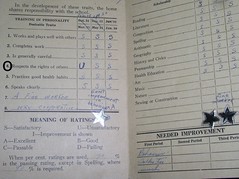
Scattered in amongst the photos are some early letters and a few report cards: here's my 4th grade report, showing the only U (unsatisfactory) grade I ever received in school, for talking too much. I was nine years old and mortified.
You can see my mother's 5th grade report card (1907!) here.
Sunday, December 24, 2006
Waiting for Godot
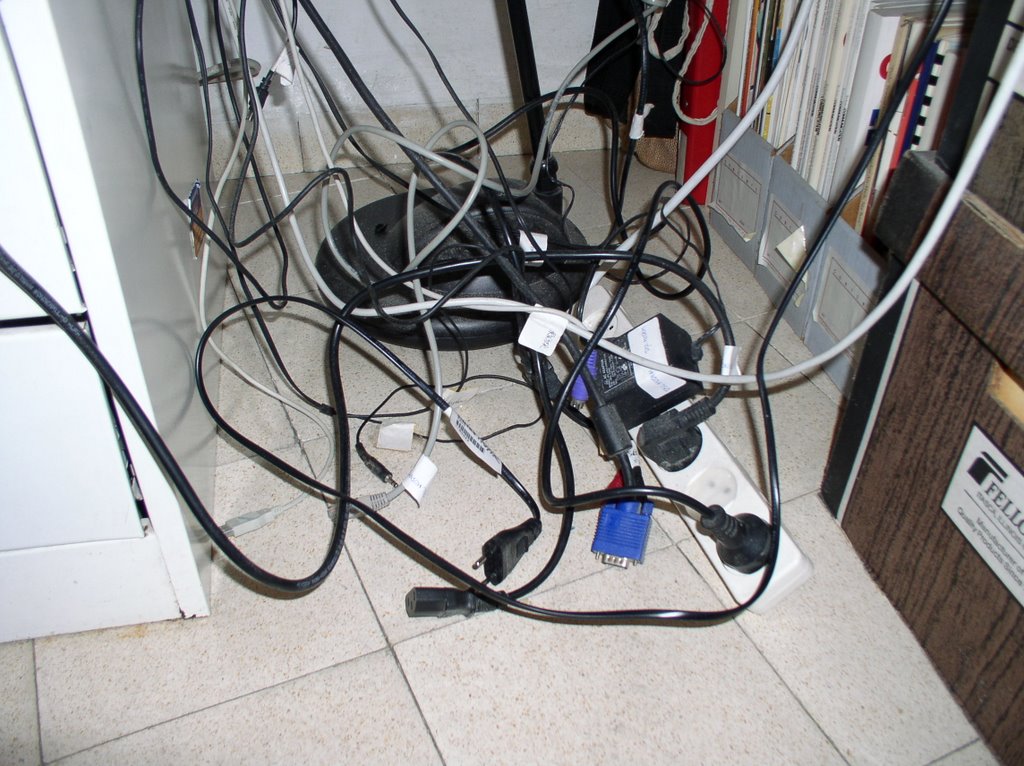 My computer went into a coma last Wednesday. It's still in the hospital. It missed the Chanuka latke party but we're hoping for a complete recovery in a day or two. Meanwhile I'm distracting myself by reading and knitting.
Merry Christmas!
Sunday, December 17, 2006
Easy Button
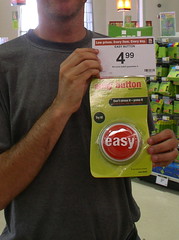
When we were shopping at Staples last summer, I decided US$4.99 was too much for a button that does nothing; I asked Prowesslessnesslessness to pose for a photo with it instead.
According to today's NY Times Magazine (I think you need to subscribe to see the article), Staples has sold nearly 1.5 million of them to date, so I guess I've been living away from the USA too long.
Scary Note: Staples marketing executive Shira Goodman claims to have been seen them in airplane cockpits.
According to today's NY Times Magazine (I think you need to subscribe to see the article), Staples has sold nearly 1.5 million of them to date, so I guess I've been living away from the USA too long.
Scary Note: Staples marketing executive Shira Goodman claims to have been seen them in airplane cockpits.
Friday, December 15, 2006
Making Chanuka Candles

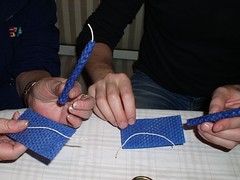
Nominally Challenged brought a Make Your Own Candles kit to Soup Salon today. I think the name is now Soup and Crafts Salon. And then we had to test our work.
Happy Chanuka!
Thursday, December 14, 2006
Fatelessness
Damn you, vonderful Noorster! You gave me a book that I hate and love at the same time. Passionately! Writing anything after reading Fatelessness is like playing the piano after hearing a Vladimir Horowitz recital. How dare I? But I am not Horowitz, I am not Kertész, I am Savtadotty and this is my blog, so I must.
I have never read a book like this…it doesn't tell, it doesn't show, it doesn't sound, it absolutely is the subject: the first-hand experiences of a teenage Hungarian boy in the concentration camps, mostly autobiographical. It accomplishes what Edward R. Murrow wanted to accomplish with his work: you are there. The Wilkinson English translation is good (recommended over the other one). Even without a sense of the Hungarian language, you can feel the formality and courtesy of the world the boy had been immersed in before he was rounded up and packed off. Even his callow adolescent arrogance comes through loud and clear, and is transformed as his narration progresses. To call it a bildungsroman would be a distortion: the young man is growing up even as society around him disintegrates. He's more like Atlas holding up the universe, the statue in front of Rockefeller Center.
How Kertész managed to do it - to stay or to become so honest - may be attributable to pure stubbornness. A stubborn adherence to his own life, to the steps that he persisted in taking, one after another. I wonder what would such stubbornness have done without something dreadful to react against? Even Auschwitz couldn't win over it. Certainly Communism didn't. He was tested and the test was found wanting. The Nobel Prize is small potatoes in the face of what Kertész has accomplished.
If you read only one book for the rest of your life, let it be this one. Slowly. I recommend one page a day for the next nine months, and at the end you may give birth to a new self. And don't worry if you feel some morning-sickness during the first trimester.
Note: if you haven't already read Kertész's 2002 Nobel Prize acceptance speech, just do it.
I have never read a book like this…it doesn't tell, it doesn't show, it doesn't sound, it absolutely is the subject: the first-hand experiences of a teenage Hungarian boy in the concentration camps, mostly autobiographical. It accomplishes what Edward R. Murrow wanted to accomplish with his work: you are there. The Wilkinson English translation is good (recommended over the other one). Even without a sense of the Hungarian language, you can feel the formality and courtesy of the world the boy had been immersed in before he was rounded up and packed off. Even his callow adolescent arrogance comes through loud and clear, and is transformed as his narration progresses. To call it a bildungsroman would be a distortion: the young man is growing up even as society around him disintegrates. He's more like Atlas holding up the universe, the statue in front of Rockefeller Center.
How Kertész managed to do it - to stay or to become so honest - may be attributable to pure stubbornness. A stubborn adherence to his own life, to the steps that he persisted in taking, one after another. I wonder what would such stubbornness have done without something dreadful to react against? Even Auschwitz couldn't win over it. Certainly Communism didn't. He was tested and the test was found wanting. The Nobel Prize is small potatoes in the face of what Kertész has accomplished.
If you read only one book for the rest of your life, let it be this one. Slowly. I recommend one page a day for the next nine months, and at the end you may give birth to a new self. And don't worry if you feel some morning-sickness during the first trimester.
Note: if you haven't already read Kertész's 2002 Nobel Prize acceptance speech, just do it.
Monday, December 11, 2006
Look Who Discovered Leonard Cohen
I vividly remember my family's teasing when someone at the dining table (often but not always me) announced with fresh awe and delight something everyone else already knew: "Look who discovered America!" they would jibe, and I sensed great affection and pride underlying the ridicule. Well Savtadotty has just discovered Leonard Cohen.
It's not as though I'd never heard of him, mind you. Just that his material in his own voice seemed too dark for me to enjoy before. Then I heard Rufus Wainwright's version of Hallelujah on Want Two, and I had a revelation: either Cohen's songs were getting more cheerful or I was growing ready for him. So yesterday, browsing at the Third Ear, I took home the DVD of a tribute concert produced by the venerable Hal Willner, and performed by some pretty cool cats: the Wainwrights (all except Loudon), one of my new favorites Joan Wasser, Bono (forgive me for mixing him up with Sonny Bono, 'cause that's just how old I am), Nick Cave, Anthony, Leonard Cohen himself, and talented others I had never heard before. They called the concert Came So Far For Beauty, most appropriately because it was performed in the Sydney (Australia) Opera House, but for me it meant a distance travelled in time as well.
Leonard Cohen appears as usual in a suit, and that just tickles me, because he looks to me like a college professor, a surgeon, Philip Roth, or a guest at a funeral. I didn't even know he was still alive. Excuse me while I go immerse myself in fandom. Look who discovered Canada!
It's not as though I'd never heard of him, mind you. Just that his material in his own voice seemed too dark for me to enjoy before. Then I heard Rufus Wainwright's version of Hallelujah on Want Two, and I had a revelation: either Cohen's songs were getting more cheerful or I was growing ready for him. So yesterday, browsing at the Third Ear, I took home the DVD of a tribute concert produced by the venerable Hal Willner, and performed by some pretty cool cats: the Wainwrights (all except Loudon), one of my new favorites Joan Wasser, Bono (forgive me for mixing him up with Sonny Bono, 'cause that's just how old I am), Nick Cave, Anthony, Leonard Cohen himself, and talented others I had never heard before. They called the concert Came So Far For Beauty, most appropriately because it was performed in the Sydney (Australia) Opera House, but for me it meant a distance travelled in time as well.
Leonard Cohen appears as usual in a suit, and that just tickles me, because he looks to me like a college professor, a surgeon, Philip Roth, or a guest at a funeral. I didn't even know he was still alive. Excuse me while I go immerse myself in fandom. Look who discovered Canada!
Saturday, December 09, 2006
Moshe Eli Caplan
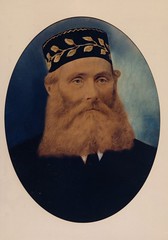
My great-grandfather. Isn't he gorgeous? He married Dvosa Galski and they had seven children: Ethel Ernestine (1865-1948) (Cousin Lucy's mother!), Rachel (1877-1960), Eva, Heinrich (my grandfather), Isak, Fani, and Essa. If any of these people are your relatives too, let me know!
So Cousin Lucy is actually my first cousin once-removed. As if it mattered.
So Cousin Lucy is actually my first cousin once-removed. As if it mattered.
Monday, December 04, 2006
Chance Favors the Prepared Mind (and Nose)
Recently it has become apparent that things which appear to happen to me by chance often are not completely accidental. I began to think along these lines a few decades ago when I saw a high school production of You Can't Take it With You, thanks to my daughter's involvement with high school dramatics. For those of you unfamiliar with this gem of a play, it has lots of fun moments, but the one that stuck with me most was the character and circumstances of the mother, who explains that she started writing plays because a typewriter was delivered to her house by mistake.
Even though it was a farce, and the whole family were exaggeratedly eccentric, something about the mother deciding to write plays for such a whimsical reason resonated for me. Whether her plays were ever produced, I gradually came to realize, was beside the point. That mother was definitely ready to try something new. Most often lately, when something happens to me "by mistake," I think about how to turn it into an adventure. This has led to some interesting turns in my life. Furthermore, I've discovered that living this way increases the occurrence of wonderful "mistakes" so now that my worldly responsibilities have shrunk I've decided to spend most of my time preparing for the next accidental happening.
And then I remembered another source of a similar lesson: a children's book called Little Bunny Follows His Nose. I'm happy to see it's still in print. It's a "scratch and sniff" book, so little kids practice identifying different scents, but the bottom line of both book and play for me is: plan less, enjoy more!
Even though it was a farce, and the whole family were exaggeratedly eccentric, something about the mother deciding to write plays for such a whimsical reason resonated for me. Whether her plays were ever produced, I gradually came to realize, was beside the point. That mother was definitely ready to try something new. Most often lately, when something happens to me "by mistake," I think about how to turn it into an adventure. This has led to some interesting turns in my life. Furthermore, I've discovered that living this way increases the occurrence of wonderful "mistakes" so now that my worldly responsibilities have shrunk I've decided to spend most of my time preparing for the next accidental happening.
And then I remembered another source of a similar lesson: a children's book called Little Bunny Follows His Nose. I'm happy to see it's still in print. It's a "scratch and sniff" book, so little kids practice identifying different scents, but the bottom line of both book and play for me is: plan less, enjoy more!
Friday, December 01, 2006
Soldiering On
Liza describes how I'm feeling better than I could. This is what I'm doing about it.
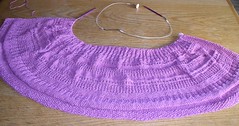
For those interested in knitting information, this is a vest that I'm designing as I go along. A first. Because I don't like stitching seams together, I decided to do the back and the fronts all together, which I can do thanks to the expandable needles I received as a gift from Pippy Bluestocking, my thoughtful D-I-L. The first advantage of designing: I can make the pockets as deep as I want! Pockets in bought sweaters, if they exist at all, are always too shallow.
For those interested in knitting information, this is a vest that I'm designing as I go along. A first. Because I don't like stitching seams together, I decided to do the back and the fronts all together, which I can do thanks to the expandable needles I received as a gift from Pippy Bluestocking, my thoughtful D-I-L. The first advantage of designing: I can make the pockets as deep as I want! Pockets in bought sweaters, if they exist at all, are always too shallow.
Subscribe to:
Posts (Atom)